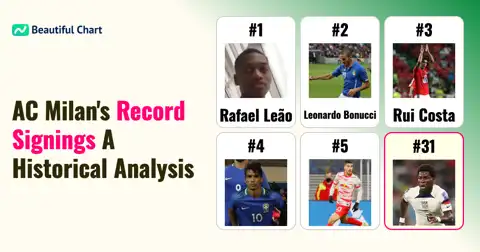
A definitive ranking of AC Milan's all-time most expensive signings reveals the club's significant investments in shaping its squad. The data, covering transfers up to the 2025/26 summer window, is topped by Rafael Leão's €49.5 million move, highlighting a history of high-stakes acquisitions. This overview captures the pivotal moments of spending that have defined different eras for the Rossoneri, from legendary playmakers to modern superstars.
A transfer fee in professional football is the financial compensation paid by one club to another to acquire a player who is under contract. This fee is determined by various factors, including the player's age, skill, contract length, and market demand. It is a primary mechanism for player movement and represents a major component of a club's budget and long-term strategy.
AC Milan's history is marked by periods of immense success, often fueled by significant financial investment in world-class talent. An examination of the club's transfer expenditures over the years provides a clear narrative of its strategic ambitions, financial power, and evolving philosophy. The club has never shied away from breaking the bank for players believed to be transformative, a trend that has persisted through various ownerships and management eras.
The Golden Era and High-Profile Playmakers
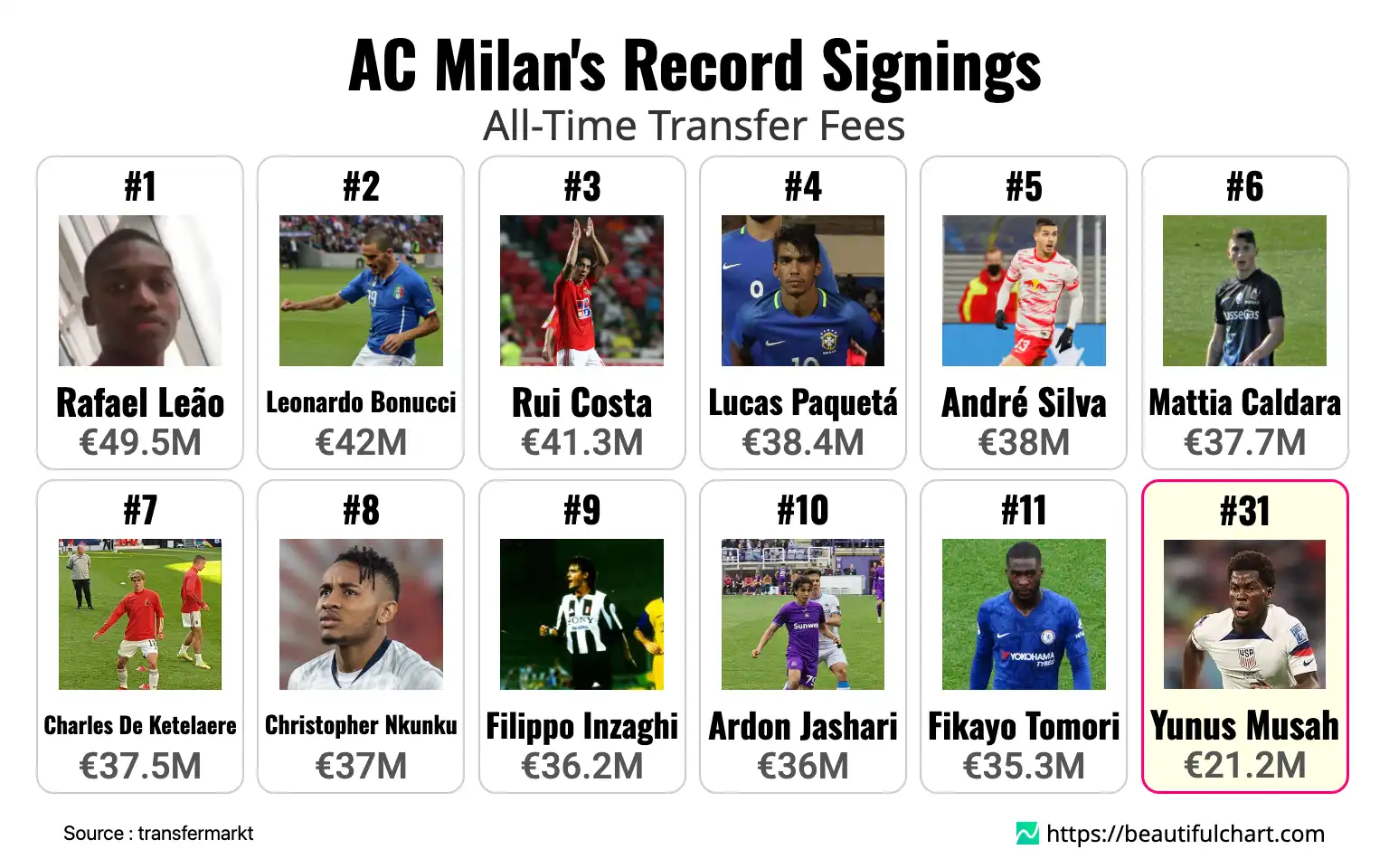
The early 2000s stand out as a period of lavish spending under the ownership of Silvio Berlusconi. This era saw the arrival of foundational players who would lead Milan to domestic and European glory. The acquisitions of Rui Costa for €41.3 million and Filippo Inzaghi for €36.2 million were statements of intent. These were not just purchases; they were cornerstone investments in building a dominant force. The subsequent signing of Alessandro Nesta from Lazio for €31 million further solidified a defense that would become legendary. This period was characterized by acquiring established, world-renowned talent, often from direct Serie A rivals, to achieve immediate success.
The Turbulent Interlude and a Spending Spree
Following a period of relative austerity, the club saw a dramatic and chaotic spending spree in the 2017/18 and 2018/19 seasons under new ownership. This window was defined by a high volume of expensive signings intended to fast-track a return to the top. The €42 million signing of Leonardo Bonucci from Juventus was the headline transfer, a move that shocked Italian football. He was joined by other costly acquisitions like André Silva (€38 million), Mattia Caldara (€37.7 million), and Lucas Paquetá (€38.4 million). While the ambition was clear, the strategy proved disjointed. Many of these high-priced players struggled to integrate or perform as expected, leading to quick departures and highlighting the risks of a scattered, high-volume investment approach.
A New Era of Calculated Investment
More recently, under the guidance of Elliott Management and now RedBird Capital, Milan's transfer strategy has become more calculated and data-driven. While the club is still willing to spend significantly, the focus has shifted towards younger players with high growth potential. The €49.5 million signing of Rafael Leão in 2019 represents the pinnacle of this modern strategy—a young talent who developed into a world-class, title-winning forward. The 2022/23 and 2023/24 seasons continued this trend with signings like Charles De Ketelaere (€37.5 million), Yunus Musah (€21.2 million), and Samuel Chukwueze (€21.1 million). These moves represent a blend of investing in potential while still paying premium fees for players identified through a rigorous scouting network. The projected high-value signings for the 2025/26 season, such as Christopher Nkunku and Ardon Jashari, suggest this philosophy of ambitious, yet strategic, squad-building will continue.
AC Milan's Record Transfer Fees

A definitive ranking of AC Milan's all-time most expensive signings reveals the club's significant investments in shaping its squad.
Key Takeaways
Key Investment Eras
- AC Milan's spending history is defined by distinct waves of major investment, most notably in the early 2000s and a massive surge in the 2017-2019 period.
- These spending sprees often align with changes in club ownership and reflect shifts in strategic priorities, from buying established stars to investing in future potential.
- The projected signings for the 2025/26 season signal a continued willingness to invest heavily in top-tier talent to remain competitive.
Sourcing and Strategy
- The club has a long history of acquiring talent from both domestic Serie A rivals and top international leagues, showcasing a global scouting network.
- Attacking players, particularly forwards and creative midfielders like Rafael Leão and Rui Costa, have historically commanded the highest transfer fees.
- The modern strategy focuses on a blend of youth and proven talent, targeting players who fit a specific tactical system and have high resale value.
Top Ranking
#1 Rafael Leão €49.5M
Signed from LOSC Lille in the 19/20 season, Rafael Leão stands as AC Milan's most expensive acquisition. The Portuguese forward initially took time to adapt but has since blossomed into one of the world's most electrifying attackers. His explosive pace, dazzling dribbling, and clinical finishing were instrumental in Milan's 2021/22 Serie A title victory, where he was named the league's MVP. His fee, once seen as a significant gamble on potential, is now considered a masterstroke, as he has become the face of the Rossoneri's modern era.
#2 Leonardo Bonucci €42M
Leonardo Bonucci's transfer from Juventus in 2017 was one of the most sensational moves in Serie A history. Appointed as captain almost immediately, his arrival was meant to signal a new, ambitious era for Milan. However, the high-profile move did not pan out as expected. The team underperformed, and Bonucci struggled to replicate his Juventus form, leading to his surprising return to Turin just one season later. The transfer is now remembered as a costly and disruptive gamble that failed to deliver on its immense promise.
#3 Rui Costa €41.3M
An iconic playmaker, Rui Costa joined AC Milan from Fiorentina in 2001 as a marquee signing of the Berlusconi era. The Portuguese maestro was the creative heart of a star-studded midfield, known for his sublime vision, passing range, and elegance on the ball. He was a key figure in the team that won the 2002/03 UEFA Champions League, forming a legendary partnership with players like Pirlo and Seedorf. His transfer represents a time when Milan consistently attracted the world's best talent to build a dominant European force.
#4 Lucas Paquetá €38.4M
Arriving from Flamengo in January 2019 with the nickname "the new Kaká," Lucas Paquetá carried immense expectations. The Brazilian midfielder showcased flashes of technical brilliance and creativity but struggled to find consistency and adapt to the tactical demands of Serie A. After a year and a half of mixed performances, he was sold to Olympique Lyonnais, where he rediscovered his form and established himself as a top midfielder in France. His time at Milan is a case of a promising talent not quite fitting in at a crucial stage of his career.
#5 André Silva €38M
Part of the massive 2017 summer spending spree, André Silva was signed from FC Porto as a highly-touted young striker expected to become Milan's next great goalscorer. Despite a respectable goal tally in the Europa League, he found it difficult to score in Serie A and struggled to live up to his hefty price tag. After loan spells at Sevilla and Eintracht Frankfurt, he was eventually sold, finding significant success in the Bundesliga. His Milan career serves as a cautionary tale about the pressures that can accompany a major transfer fee.
#31 Yunus Musah €21.2M
Signed from Valencia in 2023, Yunus Musah represents AC Milan's modern transfer strategy of targeting young, dynamic, and versatile players. As a full international for the United States Men's National Team, his arrival also brought significant attention from the American market. Musah's energy, athleticism, and ability to play in multiple midfield roles make him a valuable asset for the team's high-tempo style. His signing is an investment in both immediate squad depth and long-term potential, fitting the club's vision for sustainable growth.
| Rank | Name | Indicator | Subindicator |
|---|---|---|---|
1 |  Rafael Leão Rafael Leão | € 49M 500K | $57M 717K |
2 |  Leonardo Bonucci Leonardo Bonucci | € 42M | $48M 972K |
3 |  Rui Costa Rui Costa | € 41M 320K | $48M 179K |
4 |  Lucas Paquetá Lucas Paquetá | € 38M 400K | $44M 774K |
5 |  André Silva André Silva | € 38M | $44M 308K |
6 |  Mattia Caldara Mattia Caldara | € 37M 740K | $44M 4K |
7 |  Charles De Ketelaere Charles De Ketelaere | € 37M 500K | $43M 725K |
8 |  Christopher Nkunku Christopher Nkunku | € 37M | $43M 142K |
9 |  Filippo Inzaghi Filippo Inzaghi | € 36M 150K | $42M 150K |
10 |  Ardon Jashari Ardon Jashari | € 36M | $41M 976K |
11 |  Fikayo Tomori Fikayo Tomori | € 35M 300K | $41M 159K |
12 |  Krzysztof Piątek Krzysztof Piątek | € 35M | $40M 810K |
13 |  Carlos Bacca Carlos Bacca | € 33M 299K | $38M 827K |
14 |  Franck Kessié Franck Kessié | € 32M | $37M 312K |
14 |  Santiago Gimenez Santiago Gimenez | € 32M | $37M 312K |
16 |  Alessandro Nesta Alessandro Nesta | € 31M | $36M 146K |
17 |  Alberto Gilardino Alberto Gilardino | € 25M | $29M 149K |
17 |  Alessio Romagnoli Alessio Romagnoli | € 25M | $29M 149K |
19 |  Tijjani Reijnders Tijjani Reijnders | € 24M 800K | $28M 916K |
20 |  Ronaldinho Ronaldinho | € 24M 150K | $28M 158K |