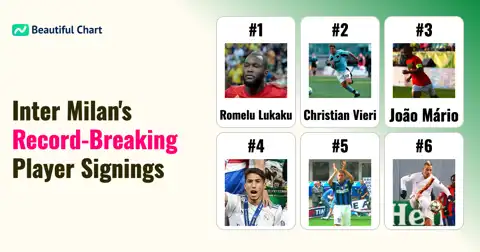
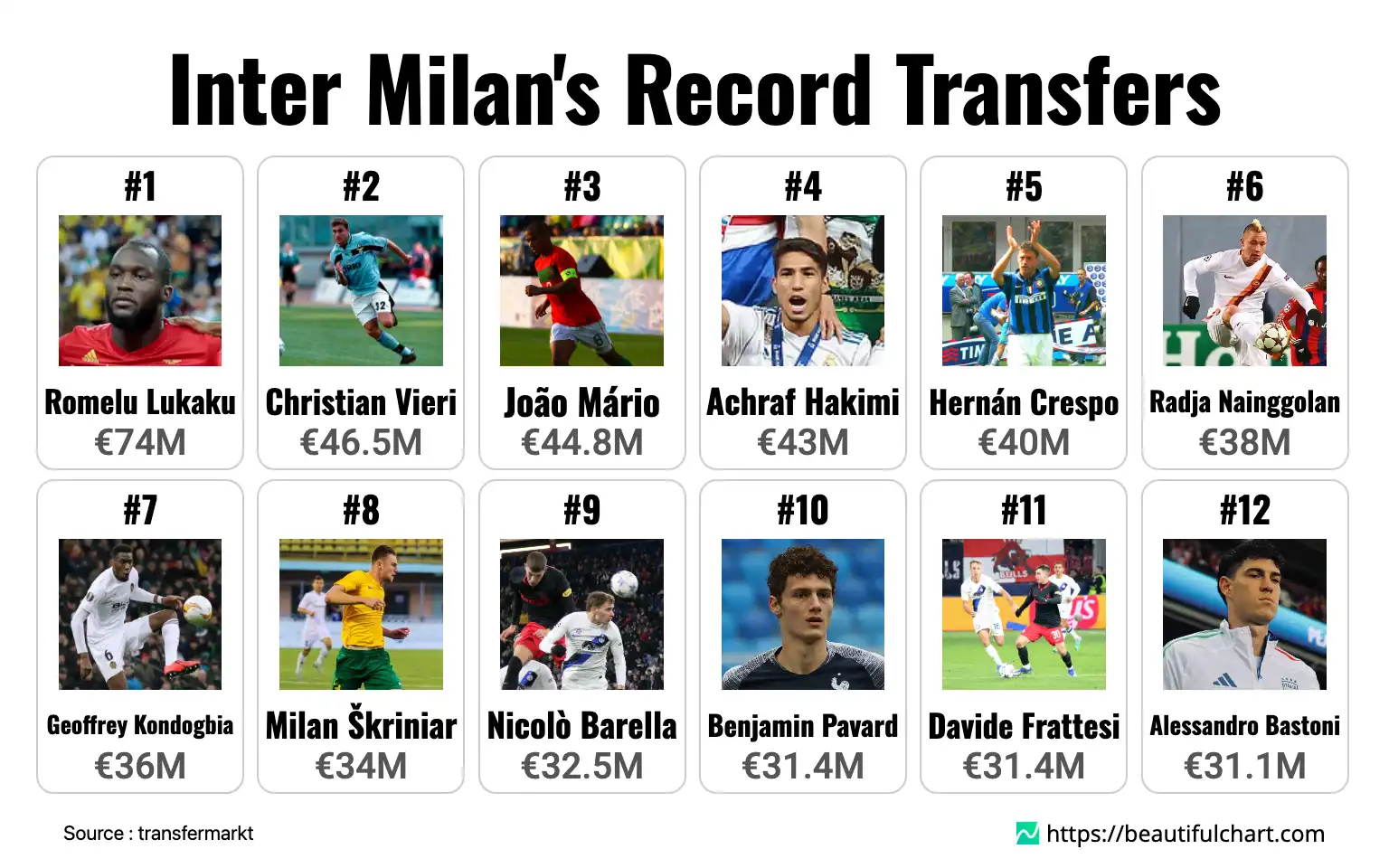
A visual breakdown of Inter Milan's transfer history reveals the club's most significant investments in player acquisitions. The data highlights Romelu Lukaku's €74 million move from Manchester United as the club's all-time record signing. Following Lukaku are historical transfers from different eras, including Christian Vieri and Hernán Crespo, showcasing periods of substantial spending. The rankings demonstrate a clear focus on acquiring top-tier attacking and defensive talent to maintain competitive strength in both domestic and European competitions.
A 'transfer fee' in football is the compensation paid by one club to another to acquire a player who is under contract. This fee is negotiated between the two clubs and can be influenced by factors such as the player's age, skill, contract length, and market demand. It represents the primary cost of purchasing a player's registration rights.
Inter Milan's history of player acquisitions reflects a club with consistent ambition, marked by distinct periods of heavy investment to secure top-tier talent. The financial outlay on players has often correlated with the club's competitive cycles, showing a willingness to break transfer records to build a squad capable of winning major honors. An examination of the most expensive signings reveals strategic patterns, positional priorities, and the economic evolution of the football transfer market.
The Two Eras of Peak Spending
The club's expenditure can be broadly categorized into two major eras. The first peak occurred in the late 1990s and early 2000s under the ownership of Massimo Moratti. This period was characterized by a desire to assemble a team of global superstars, or 'Galácticos'. Signings like Christian Vieri for €46.5 million in 1999 and Hernán Crespo for €40 million in 2002 were statement transfers that shattered records at the time. These moves signaled Inter's intent to dominate Serie A and the UEFA Champions League, bringing some of the world's most prolific strikers to the San Siro. This era was defined by passion-driven investment, with a focus on marquee names to elevate the club's global profile.
The second major wave of spending began in the late 2010s and continues into the present, driven by new ownership and a more strategic, data-informed approach to recruitment. The club-record signing of Romelu Lukaku for €74 million in 2019 was the cornerstone of a project that culminated in a Serie A title. This was followed by other significant investments like Achraf Hakimi (€43 million) and Nicolò Barella (€32.5 million), players who were crucial to the team's tactical system under coach Antonio Conte. Unlike the Moratti era, these recent high-value transfers appear more integrated into a specific sporting project, targeting players who fit a defined tactical identity rather than just their star power.
Strategic Focus on Key Positions
A closer look at the composition of the most expensive signings shows a clear prioritization of certain positions. Historically, Inter has invested heavily in world-class strikers. Names like Romelu Lukaku, Christian Vieri, Hernán Crespo, Ronaldo, and Diego Milito feature prominently. This underscores a long-standing philosophy that a dominant goal-scorer is essential for success. These investments have often paid off, with many of these forwards leading the club to domestic and international glory.
In recent years, there has also been a notable emphasis on dynamic, modern defenders and wing-backs. The acquisitions of Achraf Hakimi, Benjamin Pavard, and Alessandro Bastoni for substantial fees highlight a tactical shift towards building from the back and utilizing attacking full-backs. Hakimi's role in the 2020-21 Scudetto-winning season, in particular, demonstrated the value of investing in elite talent in this position. This strategic pivot reflects the evolution of modern football, where defenders are not just responsible for preventing goals but are also integral to initiating attacks and providing width.
Navigating the Modern Transfer Market
The financial landscape of football has changed dramatically, and Inter's transfer strategy has adapted accordingly. While the club is still capable of making high-value signings, there is a greater emphasis on sustainability and smart investment. The deals for players like Davide Frattesi and the structure of payments, often involving initial loans with obligations to buy, reflect a more cautious approach dictated by Financial Fair Play (FFP) regulations. The club has also become adept at generating significant income through player sales, allowing it to reinvest in the squad. The sale of players like Lukaku and Hakimi for substantial profits after successful spells at the club is a testament to this new, more balanced model of operation. This approach allows Inter to remain competitive at the highest level while maintaining a healthier financial footing.
Inter Milan's Record Transfers

A visual breakdown of Inter Milan's transfer history reveals the club's most significant investments in player acquisitions.
Key Takeaways
Spending Eras and Strategy
- Inter Milan's transfer spending is marked by two distinct high-investment periods: the late 1990s/early 2000s and the late 2010s to the present.
- The earlier era focused on acquiring global superstars like Christian Vieri and Hernán Crespo.
- The modern era, highlighted by the signing of Romelu Lukaku, is characterized by more strategic acquisitions tailored to specific tactical systems.
Positional Investment Priorities
- The club has historically prioritized investing in world-class strikers to lead their attack, a trend that continues to this day.
- In recent years, there has been a significant increase in spending on dynamic defenders and wing-backs like Achraf Hakimi and Benjamin Pavard.
- This shift reflects modern football's tactical emphasis on building from the back and utilizing attacking defenders.
Market Adaptation and Financial Health
- Inter has adapted to modern financial regulations by employing structured deals, such as loans with an obligation to buy.
- The club has successfully balanced its books by selling players for a significant profit, enabling reinvestment into the squad.
- This sustainable model allows the club to compete for top talent while adhering to Financial Fair Play (FFP) rules.
Top Ranking
#1 Romelu Lukaku: €74M
Romelu Lukaku's arrival from Manchester United in the 19/20 season marked a new era for Inter Milan, making him the club's most expensive signing ever. The Belgian striker was the centerpiece of Antonio Conte's project, and he delivered spectacularly. His power, pace, and clinical finishing were instrumental in leading Inter to its first Serie A title in 11 years in the 2020-21 season. Lukaku scored 64 goals in 95 appearances, forming a formidable partnership with Lautaro Martínez and becoming a fan favorite before his eventual high-profile departure.
#2 Christian Vieri: €46.5M
In 1999, Christian Vieri's transfer from Lazio to Inter for a then-world-record fee was a massive statement of intent from president Massimo Moratti. Vieri was one of the most feared strikers of his generation, a complete forward who combined brute strength with lethal finishing. Despite numerous injuries, his goal-scoring record at Inter was phenomenal, as he netted 123 goals in 190 games. He won the Capocannoniere (Serie A top scorer) award in 2002-03 and remains an iconic figure of that high-spending era.
#3 João Mário: €44.8M
Signed from Sporting CP after an impressive Euro 2016 campaign with Portugal, João Mário's transfer in the 16/17 season was a significant investment intended to revitalize Inter's midfield. He was expected to be the creative hub of the team, possessing technical skill and passing range. However, his time at the club was inconsistent, and he struggled to live up to the hefty price tag and the high expectations. After failing to secure a permanent spot in the starting lineup under several managers, he was sent on multiple loans before eventually leaving the club.
#4 Achraf Hakimi: €43M
Achraf Hakimi's signing from Real Madrid in the 20/21 season proved to be a masterstroke, even if his stay was brief. The Moroccan wing-back was a perfect fit for Antonio Conte's 3-5-2 system, providing blistering pace, attacking threat, and defensive work rate on the right flank. He was a key protagonist in Inter's Scudetto-winning campaign, contributing 7 goals and 10 assists in Serie A. His impact was immediate and transformative, and his subsequent sale to Paris Saint-Germain a year later for a significant profit highlighted Inter's new, shrewder business model.
#5 Hernán Crespo: €40M
Signed from Lazio in 2002 as a direct replacement for the departing Ronaldo, Hernán Crespo was another major striking acquisition during the Moratti era. The Argentine forward was a proven goal-scorer with a reputation for excellence in the air and clinical finishing. His first season was hampered by a serious injury, but he still managed to score crucial goals in both Serie A and the Champions League. Though his initial spell was short, he later returned to the club on loan and contributed to three consecutive Serie A titles from 2006 to 2009.
| Rank | Name | Indicator | Subindicator |
|---|---|---|---|
1 |  Romelu Lukaku Romelu Lukaku | € 74M | $86M 284K |
2 |  Christian Vieri Christian Vieri | € 46M 480K | $54M 195K |
3 |  João Mário João Mário | € 44M 780K | $52M 213K |
4 |  Achraf Hakimi Achraf Hakimi | € 43M | $50M 138K |
5 |  Hernán Crespo Hernán Crespo | € 40M | $46M 640K |
6 |  Radja Nainggolan Radja Nainggolan | € 38M | $44M 308K |
7 |  Geoffrey Kondogbia Geoffrey Kondogbia | € 36M | $41M 976K |
8 |  Milan Škriniar Milan Škriniar | € 34M | $39M 644K |
9 |  Nicolò Barella Nicolò Barella | € 32M 500K | $37M 895K |
10 |  Benjamin Pavard Benjamin Pavard | € 31M 400K | $36M 612K |
10 |  Davide Frattesi Davide Frattesi | € 31M 400K | $36M 612K |
12 |  Alessandro Bastoni Alessandro Bastoni | € 31M 100K | $36M 262K |
13 |  Gabriel Barbosa Gabriel Barbosa | € 29M 500K | $34M 397K |
14 |  Diego Milito Diego Milito | € 28M | $32M 647K |
15 |  Robin Gosens Robin Gosens | € 27M 400K | $31M 948K |
16 |  Joaquin Correa Joaquin Correa | € 27M 300K | $31M 831K |
17 |  Christian Eriksen Christian Eriksen | € 27M | $31M 481K |
18 |  Ronaldo Ronaldo | € 26M 500K | $30M 898K |
18 |  Francesco Toldo Francesco Toldo | € 26M 500K | $30M 898K |
20 |  Lautaro Martínez Lautaro Martínez | € 25M | $29M 149K |