
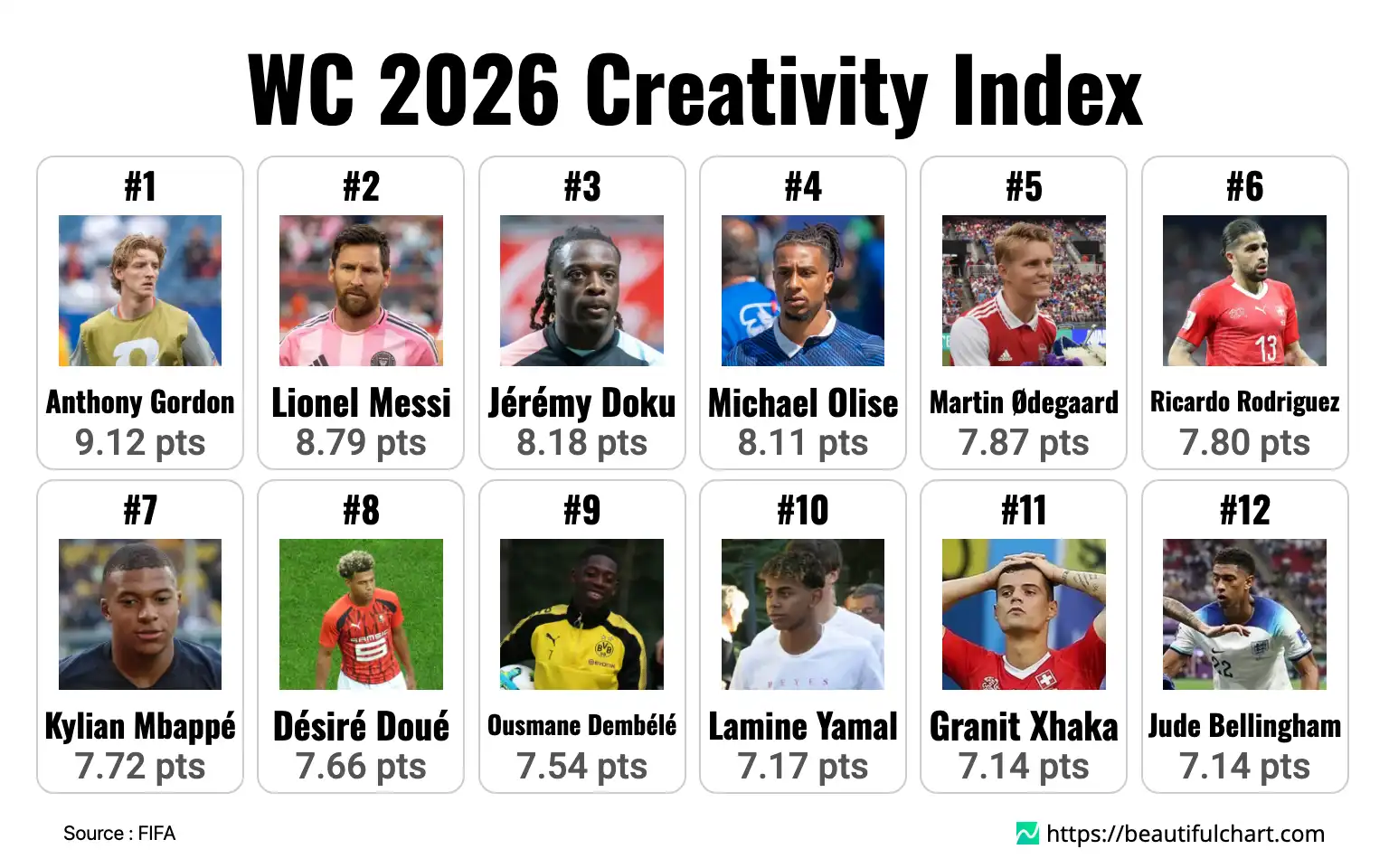
The quarterfinals of the global tournament have showcased a remarkable display of attacking ingenuity and tactical brilliance. Analyzing the creativity index reveals how specific players are single-handedly dismantling structured defenses. These numbers provide a fascinating glimpse into the evolving role of modern playmakers on the biggest international stage.
Playmaking refers to the ability of a player to read the game, anticipate movements, and deliver incisive passes or dribbles that create goal-scoring opportunities, often acting as the tactical focal point of their team's offense.
The landscape of international football is undergoing a profound tactical transformation, and the creative forces driving this change have never been more apparent. When we look closely at the offensive dynamics of elite teams during these high-stakes quarterfinal matchups, it becomes clear that raw athleticism and structured defensive setups are no longer enough to secure victory at the highest level. The real difference-makers are those individuals who possess the unique ability to see passes that others cannot and execute them with pinpoint accuracy.
It is fascinating to observe how different nations cultivate and utilize these creative talents. Traditionally, we might expect a classic central attacking midfielder to dominate the playmaking statistics. However, the current trend points towards a much more decentralized approach to chance creation. Dynamic wingers and deep-lying orchestrators are increasingly responsible for unlocking stubborn defenses. This evolution reflects a broader tactical shift where fluidity and positional interchangeability are prioritized over rigid, predictable formations. The emphasis is entirely on players who can operate effectively in tight spaces, make rapid decisions, and execute high-risk, high-reward actions that completely break the lines of the opposition.
Furthermore, the sheer variety of creative styles on display is a testament to the global nature of the sport. From explosive, dribble-heavy approaches that physically disrupt defensive structures to calculated, possession-based orchestration that methodically stretches opponents out of position, there is clearly no single blueprint for success. This diversity not only makes for highly entertaining spectacles but also presents complex, often unsolvable challenges for opposing managers. Preparing to face a team equipped with a highly rated creative hub requires meticulous planning and often necessitates significant tactical compromises that can leave other areas vulnerable.
Interestingly, while the tactical frameworks surrounding these players are becoming progressively more sophisticated, the core essence of elite playmaking remains deeply rooted in pure individual instinct and technical mastery. It is about that split-second recognition of a fleeting opening and the absolute confidence to exploit it. The data highlights a critical reality: in tight knockout encounters, where the margins are incredibly slim, the presence of a truly visionary talent can be the sole deciding factor between advancing to the semifinals and going home early. As the game continues to evolve, the premium placed on these individuals will only increase, cementing their status as the most crucial components of any ambitious national team.

2026 World Cup Quarterfinals
The quarterfinals of the global tournament have showcased a remarkable display of attacking ingenuity and tactical brilliance.
Data Source: FIFA
Image Source: Freepik from www.flaticon.com
Key Takeaways
The Rise of Dynamic Wingers
- Traditional central playmakers are increasingly sharing creative duties with dynamic wide players.
- Wingers utilizing pace and technical skill are proving essential for breaking down low-block defenses.
- This shift emphasizes individual ability in one-on-one situations as a primary source of chance creation.
Sustained Brilliance of Veterans
- Experienced maestros continue to exert massive influence on high-stakes international matches.
- Their deep understanding of the game compensates for any physical decline, allowing them to control the tempo.
- Vision and precise execution remain invaluable assets in knockout football environments.
Data-Driven Tactical Evolution
- Advanced metrics are uncovering the nuanced ways players contribute to offensive phases beyond simple assists.
- Teams are structuring their attacks to maximize the output of their highest-rated creative individuals.
- The integration of analytical insights is shaping how managers approach game plans in critical tournament stages.
Top Ranking
#1 Anthony Gordon 9.12
Anthony Gordon has been a revelation, providing an unparalleled spark for his team. His ability to find pockets of space and deliver crucial passes under immense pressure has set a new standard. His high score reflects a dynamic mix of pace, vision, and precise decision-making in the final third.
#2 Lionel Messi 8.79
Even at this stage of his career, Lionel Messi continues to orchestrate attacks with unmatched elegance and vision. His mastery over the tempo of the game and his uncanny ability to thread impossible passes remain central to his team's success. The statistics confirm his creative genius is still a dominant force.
#3 Jérémy Doku 8.18
Jérémy Doku brings an explosive element to the pitch, combining breathtaking dribbling skills with an unpredictable edge. His direct style of play constantly puts defenders on their heels, creating numerous openings. This high ranking is a testament to his sheer ability to disrupt defensive formations.
#4 Michael Olise 8.11
Michael Olise has demonstrated a mature and highly effective approach to unlocking opposing defenses. His precise crossing and clever movement between the lines have been instrumental in constructing dangerous attacking sequences. He consistently proves to be a vital cog in the offensive machinery.
#5 Martin Ødegaard 7.87
Martin Ødegaard operates as the quintessential modern midfielder, blending exceptional technical ability with outstanding spatial awareness. His capacity to dictate play and execute complex attacking maneuvers makes him a constant threat. His score highlights his crucial role as a primary orchestrator.
| Rank | Name | Indicator | Subindicator |
|---|---|---|---|
1 |  Anthony Gordon Anthony Gordon | 9.12 pts | Attack - 3 |
2 |  Lionel Messi Lionel Messi | 8.79 pts | Attack - 5 |
3 |  Jérémy Doku Jérémy Doku | 8.18 pts | Attack - 5 |
4 |  Michael Olise Michael Olise | 8.11 pts | Attack - 4 |
5 |  Martin Ødegaard Martin Ødegaard | 7.87 pts | Attack - 4 |
6 |  Ricardo Rodriguez Ricardo Rodriguez | 7.80 pts | Attack - 11 |
7 |  Kylian Mbappé Kylian Mbappé | 7.72 pts | Attack - 1 |
8 |  Désiré Doué Désiré Doué | 7.66 pts | Attack - 3 |
9 |  Ousmane Dembélé Ousmane Dembélé | 7.54 pts | Attack - 2 |
10 |  Lamine Yamal Lamine Yamal | 7.17 pts | Attack - 3 |
11 |  Granit Xhaka Granit Xhaka | 7.14 pts | Attack - 8 |
11 |  Jude Bellingham Jude Bellingham | 7.14 pts | Attack - 1 |
13 |  Bukayo Saka Bukayo Saka | 6.96 pts | Attack - 6 |
14 |  Timothy Castagne Timothy Castagne | 6.91 pts | Attack - 4 |
15 |  Noni Madueke Noni Madueke | 6.85 pts | Attack - 12 |
16 |  Eberechi Eze Eberechi Eze | 6.81 pts | Attack - 10 |
17 |  Azzedine Ounahi Azzedine Ounahi | 6.66 pts | Attack - 5 |
18 |  Dan Ndoye Dan Ndoye | 6.64 pts | Attack - 1 |
19 |  Djed Spence Djed Spence | 6.54 pts | Attack - 8 |
19 |  Elliot Anderson Elliot Anderson | 6.54 pts | Attack - 28 |


