
The landscape of international football defense has been reshaped during the thrilling quarter-finals of the 2026 World Cup. As powerhouse nations battled for supremacy, certain players emerged as impenetrable walls for their teams, completely shutting down some of the world's most lethal attackers. This comprehensive ranking highlights the defensive maestros who have dictated the tempo and secured crucial victories on the biggest stage. Dive into the tactical brilliance and sheer physical dominance that defined the quarter-final matchups.
Power Ranking: A metric-based evaluation system used to assess and compare the current form, influence, and overall performance levels of individual players or teams within a specific tournament context.
The quarter-final stage of the 2026 World Cup provided a fascinating study in tactical discipline and defensive resilience. With matches like France's clinical 2-0 victory over Morocco and Argentina's commanding 3-1 win against Switzerland, the importance of a solid backline and robust defensive midfield was laid bare. The dominance of European and South American defenders in the upper echelons of the performance metrics underscores the tactical evolution occurring in these regions, prioritizing not just tackling and interception, but also ball progression and spatial awareness.
Looking at the upper tier of defensive performers, there is a clear trend towards versatile players who can transition seamlessly between defensive duties and midfield distribution. Adrien Rabiot and Manu Koné's exceptional ratings reflect France's suffocating midfield control, which completely neutralized the Moroccan counter-attack. Their ability to win ground duels and immediately launch offensive transitions is a hallmark of modern tournament football. Similarly, Rodri's presence for Spain against Belgium highlights the critical nature of the 'number six' role in maintaining possession and breaking up opposition play before it reaches the defensive third.
Furthermore, the data indicates a significant reliance on physically imposing and aerially dominant center-backs. Players like Kristoffer Ajer played pivotal roles in high-stakes encounters, as seen in Norway's tight battle with England. The modern defender must possess the physical attributes to deal with crosses and set-pieces, while also possessing the technical proficiency to play out from the back under intense pressing. The performance of the Argentine defense, led by figures like Lisandro Martínez and Cristian Romero, further exemplifies this blend of aggression and technical quality, successfully stifling the Swiss attack.
The contrasting styles of the quarter-finalists also shaped the defensive demands. Teams employing high defensive lines required extraordinary recovery pace and anticipation, while those sitting in deeper blocks relied on sheer volume of clearances and blocked shots. The top-ranked individuals represent a masterclass in executing these varied tactical instructions flawlessly under immense pressure. As the tournament progresses, the structural integrity provided by these elite defenders will undoubtedly be the foundation upon which championship campaigns are built. The evolution of the defensive role is apparent; it is no longer merely about destruction, but rather the intelligent orchestration of the team's entire tactical framework from the back.

2026 World Cup Quarter-Finals
The landscape of international football defense has been reshaped during the thrilling quarter-finals of the 2026 World Cup.
Key Takeaways
Tactical Evolution in Defense
- The role of the defensive midfielder has become indistinguishable from traditional center-backs in terms of overall defensive importance.
- Successful teams rely heavily on players who can dictate play from deep and break opposition lines.
- High-pressing systems require defenders with exceptional anticipation and recovery speed.
Impact of Quarter-Final Matchups
- France's midfield dominance was a critical factor in their clean sheet against a dangerous Moroccan side.
- Argentina's aggressive defensive structure effectively neutralized Switzerland's organized attacking patterns.
- Tight matches, such as Norway versus England, highlight the crucial nature of aerial dominance and physical duels.
Top Ranking
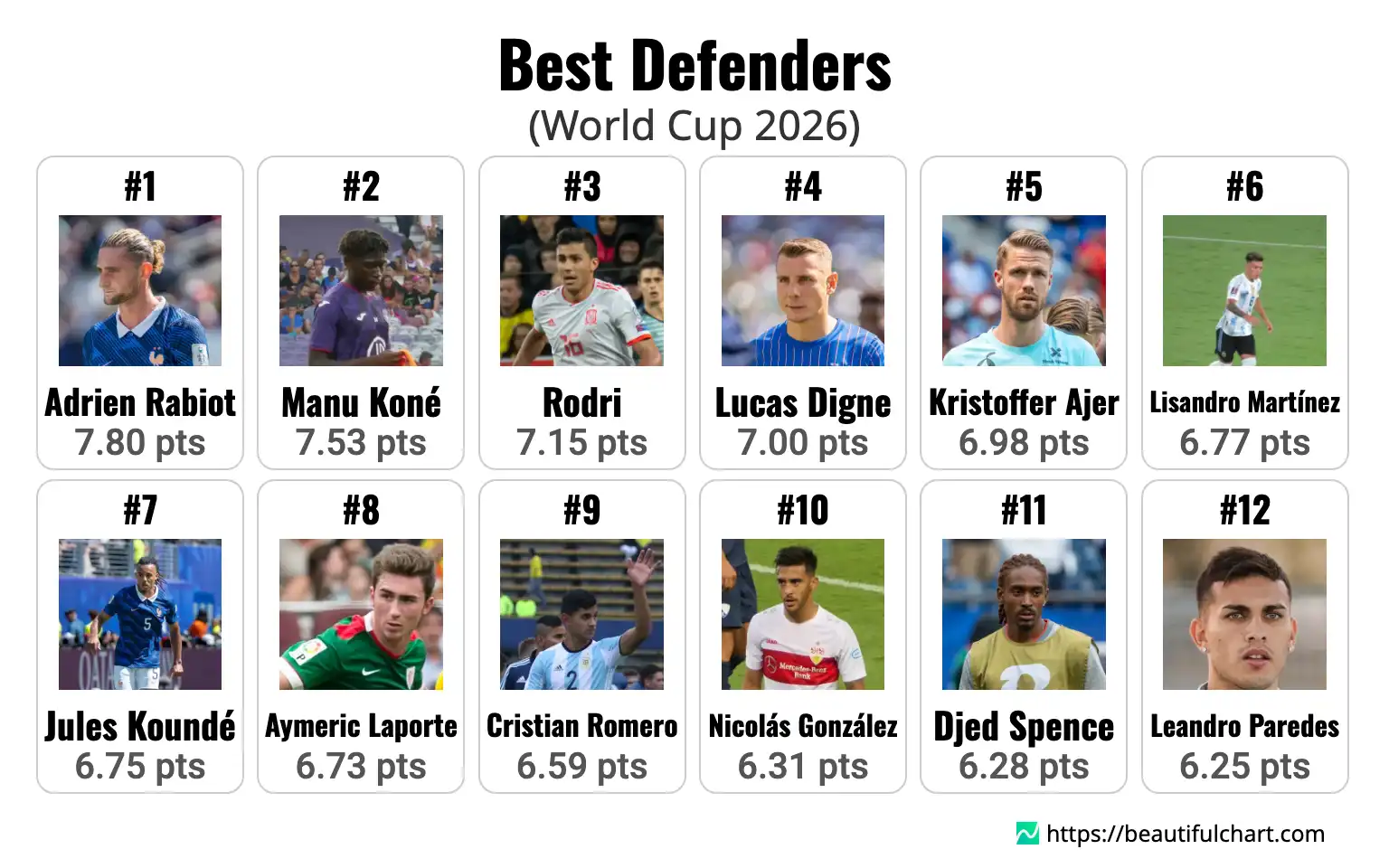
#1 Adrien Rabiot 7.80 pts
Adrien Rabiot delivered a masterclass in midfield control and defensive positioning during the quarter-finals. His ability to intercept passes, break up opposition attacks, and immediately transition the ball forward was instrumental in his team's success. He consistently demonstrated exceptional tactical awareness, ensuring the defensive line was shielded effectively while contributing significantly to ball progression.
#2 Manu Koné 7.53 pts
Manu Koné showcased immense physical presence and tenacity, acting as a disruptive force against opposing attackers. His high volume of successful tackles and ball recoveries highlighted his crucial role in dismantling offensive plays before they could develop into serious threats. Koné's relentless energy and discipline provided a solid foundation, allowing his more attacking teammates the freedom to push forward.
#3 Rodri 7.15 pts
Rodri's performance epitomized the modern defensive anchor, combining physical robustness with elite technical distribution. He acted as the metronome for his side, dictating the tempo of the game while simultaneously serving as the primary shield for the center-backs. His impeccable reading of the game allowed him to consistently extinguish dangerous situations with precise positioning and timely interceptions.
#4 Lucas Digne 7.00 pts
Lucas Digne provided a stellar defensive display from the flank, completely neutralizing wide threats with his aggressive pressing and intelligent positioning. Beyond his core defensive duties, he exhibited fantastic recovery pace and spatial awareness, frequently tracking back to cover defensive gaps. His ability to balance defensive solidity with overlapping runs made him a dual threat on the pitch.
#5 Kristoffer Ajer 6.98 pts
Kristoffer Ajer was a colossal figure in the heart of the defense, utilizing his towering physique to dominate aerial duels and clear dangerous crosses. His commanding presence intimidated opposing forwards, while his composure on the ball allowed his team to confidently build play from the back. Ajer's crucial blocks and last-ditch tackles were vital in maintaining defensive structural integrity under heavy pressure.
| Rank | Name | Indicator | Subindicator |
|---|---|---|---|
1 |  Adrien Rabiot Adrien Rabiot | 7.80 pts | Attack - 13 |
2 |  Manu Koné Manu Koné | 7.53 pts | Attack - 9 |
3 |  Rodri Rodri | 7.15 pts | Attack - 19 |
4 |  Lucas Digne Lucas Digne | 7 pts | Attack - 15 |
5 |  Kristoffer Ajer Kristoffer Ajer | 6.98 pts | Attack - 24 |
6 |  Lisandro Martínez Lisandro Martínez | 6.77 pts | Attack - 19 |
7 |  Jules Koundé Jules Koundé | 6.75 pts | Attack - 16 |
8 |  Aymeric Laporte Aymeric Laporte | 6.73 pts | Attack - 25 |
9 |  Cristian Romero Cristian Romero | 6.59 pts | Attack - 26 |
10 |  Nicolás González Nicolás González | 6.31 pts | Attack - 10 |
11 |  Djed Spence Djed Spence | 6.28 pts | Attack - 8 |
12 |  Leandro Paredes Leandro Paredes | 6.25 pts | Attack - 29 |
13 |  William Saliba William Saliba | 6.19 pts | Attack - 23 |
14 |  Pedri Pedri | 6.17 pts | Attack - 17 |
15 |  Désiré Doué Désiré Doué | 6.12 pts | Attack - 3 |
15 |  Pedro Porro Pedro Porro | 6.12 pts | Attack - 18 |
17 |  Fredrik Aursnes Fredrik Aursnes | 6.07 pts | Attack - 16 |
18 |  Declan Rice Declan Rice | 6 pts | Attack - 19 |
19 |  Anass Salah-Eddine Anass Salah-Eddine | 5.98 pts | Attack - 21 |
20 |  Alexander Sørloth Alexander Sørloth | 5.92 pts | Attack - 9 |


