
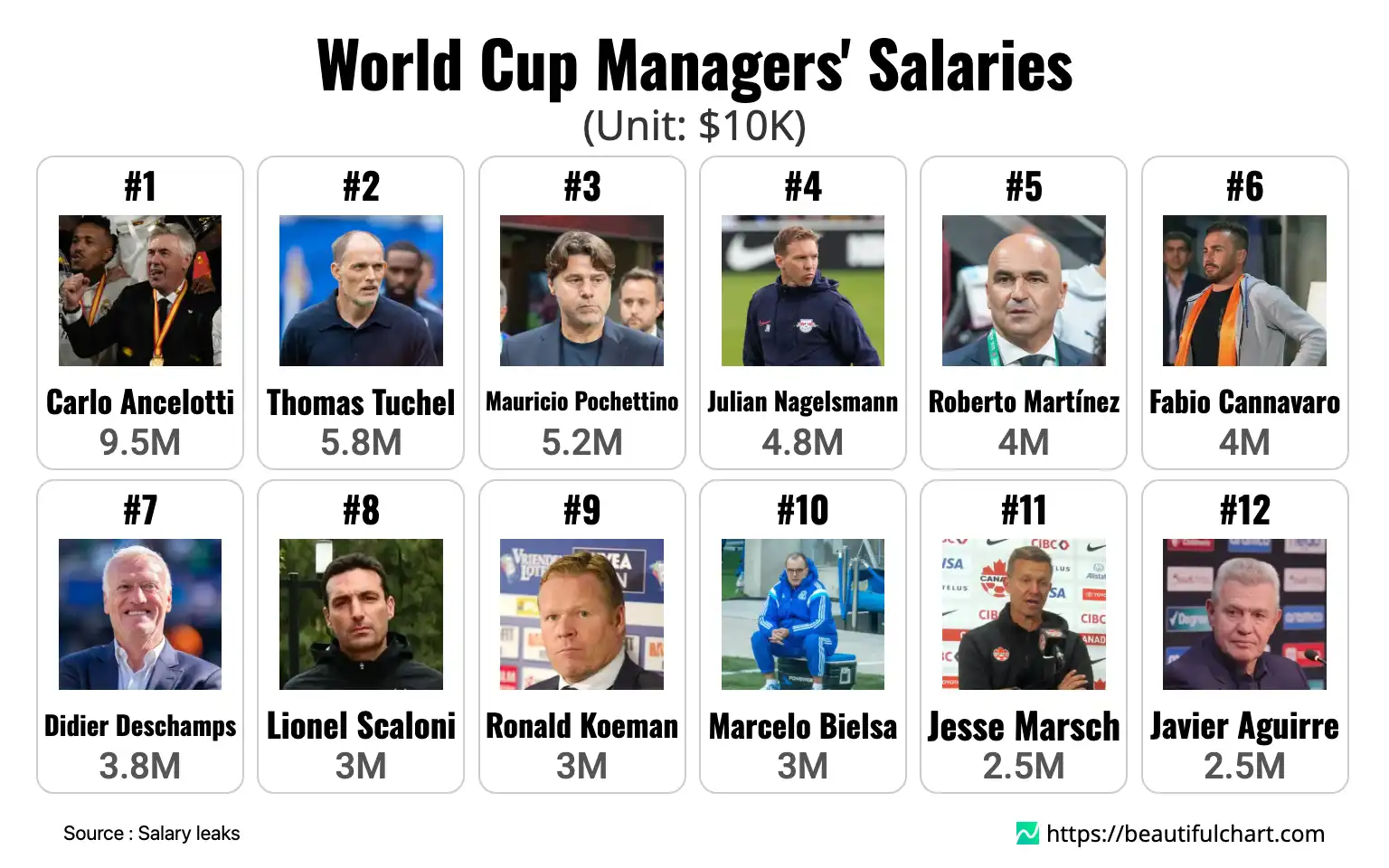
The 2026 FIFA World Cup will feature some of the world's highest-paid football managers on the grandest stage. Carlo Ancelotti leads the field with a staggering $9.5M annual salary, nearly double that of second-placed Thomas Tuchel at $5.8M. The salary gap between top earners and the rest of the field is striking, with the bottom half of managers earning under $1M per year. From elite European tacticians commanding multi-million dollar contracts to coaches from developing football nations working on modest budgets, this ranking reflects the vast economic disparity within the global game.
Manager Salary (National Team): The annual compensation paid by a national football federation to its head coach. This figure typically includes a base salary and may vary depending on bonuses, tenure, and the financial resources of the employing federation.
Few events in world sports generate as much attention as the FIFA World Cup, and the 2026 edition — hosted across the United States, Canada, and Mexico — is no exception. As 48 nations prepare to compete, the financial structures behind their coaching staffs reveal just as much about global football as the teams themselves.
The Elite Tier: Million-Dollar Managers
Carlo Ancelotti sits alone at the top with an annual salary of $9.5M, a figure that reflects both his track record and the financial power of the federation he represents. The Italian's career includes multiple Champions League titles and league championships across Europe's top leagues, making him one of the most decorated managers in football history. His salary is nearly 64% higher than the second-ranked Thomas Tuchel at $5.8M, who took charge of the England national team following stints at Chelsea and Bayern Munich.
Mauricio Pochettino ($5.2M) and Julian Nagelsmann ($4.8M) round out the top four, both managing major footballing nations with significant commercial and sporting ambitions. Roberto Martínez and Fabio Cannavaro are tied at $4M, representing two very different footballing cultures — Martínez leading Portugal and Cannavaro at the helm of Saudi Arabia.
The Mid-Range: Established Names, Competitive Salaries
Didier Deschamps ($3.8M) brings France to the tournament as one of the tournament favorites, and his salary reflects his long tenure and consistent success with Les Bleus. Lionel Scaloni ($3M), Ronald Koeman ($3M), and Marcelo Bielsa ($3M) are grouped together — a reigning World Cup champion, an experienced Dutch pragmatist, and one of football's most ideologically driven coaches — all valued similarly by their respective federations.
Jesse Marsch ($2.5M) represents the United States, a host nation with growing commercial ambitions and a federation increasingly willing to invest in managerial talent. His salary reflects both the USSF's ambitions and the broader growth of soccer culture in North America. Javier Aguirre ($2.5M) and Gustavo Alfaro ($2.5M) are also in the same bracket, managing Mexico and Costa Rica respectively.
The Budget End: Modest Pay, Meaningful Roles
Below the $1M mark, the salary structure changes dramatically. Hugo Broos ($900K), Hajime Moriyasu ($865K), Walid Regragui ($775K), and Thomas Christiansen ($725K) are among those managing nations where football federations operate on tighter budgets but have still achieved World Cup qualification — no small feat.
At the lower end, coaches such as Hossam Hassan ($156K), Darren Bazeley ($130K), and Bubista ($110K) earn salaries that are a fraction of the top earners, yet they have guided their national teams through competitive qualifying campaigns.
What the Numbers Tell Us
The salary data highlights a clear economic stratification in international football. The top six earners collectively command over $33M in annual salaries, while the bottom ten combined earn less than $2M. This disparity mirrors the broader wealth gap in global football, where federations from Europe and wealthy Gulf states can attract elite managerial talent, while African, Asian, and Pacific Island nations often work within significantly tighter constraints.
It is also worth noting that salary does not directly correlate with tournament success. Several World Cup winners have been managed by coaches earning far less than their opponents. Qualification alone, regardless of the coach's pay grade, represents a significant achievement for many of the nations represented in this ranking.

2026 World Cup Managers Salary Rankings
The 2026 FIFA World Cup will feature some of the world's highest-paid football managers on the grandest stage.
Data Source: Salary leaks
Image Source: Freepik from www.flaticon.com
Key Takeaways
Massive Salary Gap at the Top
- Carlo Ancelotti's $9.5M salary is nearly double that of second-placed Thomas Tuchel ($5.8M)
- The top 6 earners account for over $33M in combined annual salaries
- A sharp drop-off occurs after the top tier, with most coaches earning under $3M
Economic Disparity Across Federations
- European and Gulf-state federations dominate the high-salary tier
- African and Pacific nations frequently operate with coaching budgets under $500K
- The lowest-paid coach earns roughly 1% of what Ancelotti receives annually
Host Nation Investment
- The United States, as a co-host of the 2026 World Cup, has invested $2.5M in Jesse Marsch
- Co-hosts Mexico (Javier Aguirre, $2.5M) and Canada (Jesse Marsch equivalent tier) reflect regional ambitions
- North American federations are increasing their coaching investment to match growing commercial interest in the sport
Top Ranking
#1 Carlo Ancelotti $9.5M
The Italian tactician commands the highest managerial salary at the 2026 World Cup by a considerable margin. With an unmatched trophy cabinet that includes multiple Champions League titles and domestic league championships across England, Italy, Spain, France, and Germany, Ancelotti's $9.5M salary reflects both his elite pedigree and the expectations placed upon him by his federation heading into the tournament.
#2 Thomas Tuchel $5.8M
The German manager earns $5.8M as head coach of the England national team, a role he took on following successful stints at Paris Saint-Germain, Chelsea, and Bayern Munich. Tuchel brings a reputation for tactical flexibility and big-game management, qualities that England's federation has paid a premium for as the nation seeks its second World Cup title.
#3 Mauricio Pochettino $5.2M
The Argentine-born coach earns $5.2M and brings an extensive background in European club football — most notably at Tottenham Hotspur and Paris Saint-Germain — to his national team role. His salary reflects his high-profile reputation and the significant expectations riding on the nation he manages heading into the 2026 tournament.
#4 Julian Nagelsmann $4.8M
At $4.8M, the German coach is one of the younger elite-level managers at the tournament. Nagelsmann built his reputation through impressive work in the Bundesliga before moving to the international stage, and his federation's willingness to invest in him signals a long-term vision for developing a tactically progressive national team identity.
#5 Roberto Martínez $4M
The Spanish coach earns $4M annually managing one of Europe's most technically gifted squads. Having previously guided Belgium through some of their most successful international years, Martínez brings proven tournament experience and a clear attacking philosophy that aligns with his current side's playing style and ambitions.
#5 Fabio Cannavaro $4M
Tied at $4M, the former World Cup-winning defender turned manager brings a high-profile name and European football credentials to his coaching role. His equal ranking with Martínez in salary terms reflects how some federations outside traditional football powerhouses are increasingly willing to invest in internationally recognized managerial names to raise their program's profile.
| Rank | Name | Indicator | Subindicator |
|---|---|---|---|
1 |  Carlo Ancelotti Carlo Ancelotti | € 9M 500K | $11M 77K |
2 |  Thomas Tuchel Thomas Tuchel | € 5M 800K | $6M 762K |
3 |  Mauricio Pochettino Mauricio Pochettino | € 5M 200K | $6M 63K |
4 |  Julian Nagelsmann Julian Nagelsmann | € 4M 800K | $5M 596K |
5 |  Roberto Martínez Roberto Martínez | € 4M | $4M 664K |
5 |  Fabio Cannavaro Fabio Cannavaro | € 4M | $4M 664K |
7 |  Didier Deschamps Didier Deschamps | € 3M 800K | $4M 430K |
8 |  Lionel Scaloni Lionel Scaloni | € 3M | $3M 498K |
8 |  Ronald Koeman Ronald Koeman | € 3M | $3M 498K |
8 |  Marcelo Bielsa Marcelo Bielsa | € 3M | $3M 498K |
11 |  Jesse Marsch Jesse Marsch | € 2M 500K | $2M 915K |
11 |  Javier Aguirre Javier Aguirre | € 2M 500K | $2M 915K |
11 |  Gustavo Alfaro Gustavo Alfaro | € 2M 500K | $2M 915K |
14 |  Julen Lopetegui Julen Lopetegui | € 2M 400K | $2M 798K |
15 |  Vincenzo Montella Vincenzo Montella | € 2M 200K | $2M 565K |
16 |  Hong Myung-bo Hong Myung-bo | € 2M 160K | $2M 518K |
17 |  Néstor Lorenzo Néstor Lorenzo | € 2M | $2M 332K |
17 |  Sebastián Beccacece Sebastián Beccacece | € 2M | $2M 332K |
17 |  Luis de la Fuente Luis de la Fuente | € 2M | $2M 332K |
20 |  Rudi Garcia Rudi Garcia | € 1M 700K | $1M 982K |


