
Breathing clean air is a fundamental human need, yet the reality varies drastically across the globe. This analysis examines the US AQI levels across numerous countries, highlighting the regions struggling with severe pollution and those maintaining cleaner skies. By looking at these figures, we can see clear regional trends and the massive disparity between industrialized nations and those in the midst of rapid development.
US AQI (Air Quality Index) is a standardized scale used by the U.S. Environmental Protection Agency to report daily air quality. It tells you how clean or polluted your air is and what associated health effects might be a concern for you, with higher numbers indicating greater pollution and health risk.
Understanding the Global Air Quality Divide
When we talk about the air we breathe, it’s easy to get lost in technical jargon. However, the reality of air pollution is a daily struggle for billions of people. Looking at the global distribution of air quality, a very clear and somewhat concerning pattern emerges. The highest levels of pollution are concentrated heavily in South Asia and the Middle East, while many Western nations, including the United States, enjoy significantly cleaner air. This isn't just a matter of luck; it’s a complex mix of geography, industrial practices, and environmental policy.
In South Asia, countries like India, Pakistan, and Bangladesh consistently sit at the top of the list for poor air quality. If you’ve ever visited or seen footage of major cities in this region, the haze is often visible to the naked eye. The causes are multifaceted: rapid urbanization, a heavy reliance on coal for energy, and seasonal agricultural practices like crop burning all contribute to a cocktail of pollutants that linger in the atmosphere. The sheer density of the population in these areas means that millions are exposed to these high AQI levels every single day, leading to significant long-term health challenges.
The Role of Geography and Industry in the Middle East
Moving toward the Middle East, nations like Bahrain and Kuwait also show high AQI values. Here, the story is a bit different. While industrial emissions from the oil and gas sectors certainly play a role, natural factors are a massive contributor. Sandstorms and airborne dust are frequent in these arid climates, naturally pushing the AQI higher. It’s a reminder that 'pollution' isn't always man-made, though industrial activity certainly exacerbates the situation. For the men in their 30s to 50s living in these regions, the intersection of rapid economic growth and harsh environmental conditions creates a unique set of living standards that differ greatly from those in more temperate, regulated climates.
Why Western Nations Like the USA Rank Differently
Interestingly, when we look further down the list at nations like the United States, the situation changes dramatically. With an AQI of 33, the U.S. ranks significantly better than many of its global peers. This isn't because the U.S. lacks industry; rather, it’s the result of decades of stringent environmental regulations, such as the Clean Air Act. The transition from heavy manufacturing to a more service-oriented economy, combined with better technology in vehicles and power plants, has allowed for much cleaner air despite high levels of economic activity. It shows that while development often brings pollution, it is possible to decouple economic growth from environmental degradation through policy and innovation.
The Human and Economic Impact
High AQI levels aren't just an environmental statistic; they are an economic and health burden. Poor air quality leads to increased healthcare costs, reduced labor productivity due to illness, and a lower overall quality of life. For those in the prime of their working years, living in a high-pollution environment can mean more respiratory issues and a shorter life expectancy. Conversely, nations that have invested in air quality are seeing the benefits in their public health outcomes and the general well-being of their citizens. The trend shifting here suggests that as developing nations mature, the pressure to adopt cleaner technologies will only increase, potentially reshaping this list in the decades to come.

Global Air Quality Rankings
Breathing clean air is a fundamental human need, yet the reality varies drastically across the globe.
Data Source: AQI
Image Source: Freepik from www.flaticon.com
Key Takeaways
Regional Pollution Hotspots
- South Asia remains the global center for high air pollution, driven by industry and agriculture.
- Middle Eastern nations face high AQI levels due to a combination of petroleum industries and natural dust.
- Developed Western nations generally maintain significantly lower AQI levels through strict regulation.
Factors Influencing Air Quality
- Rapid urbanization and population density correlate strongly with higher pollution levels.
- Natural geography, such as desert environments, plays a significant role in baseline AQI.
- Environmental policies and the shift toward cleaner energy sources are effective in reducing pollution.
Health and Economic Consequences
- Countries with high AQI levels face increased public health expenditures and lower productivity.
- Clean air is increasingly seen as a competitive advantage for attracting talent and maintaining a healthy workforce.
- Technological innovation in the energy and automotive sectors is the primary driver for improving air quality.
Top Ranking
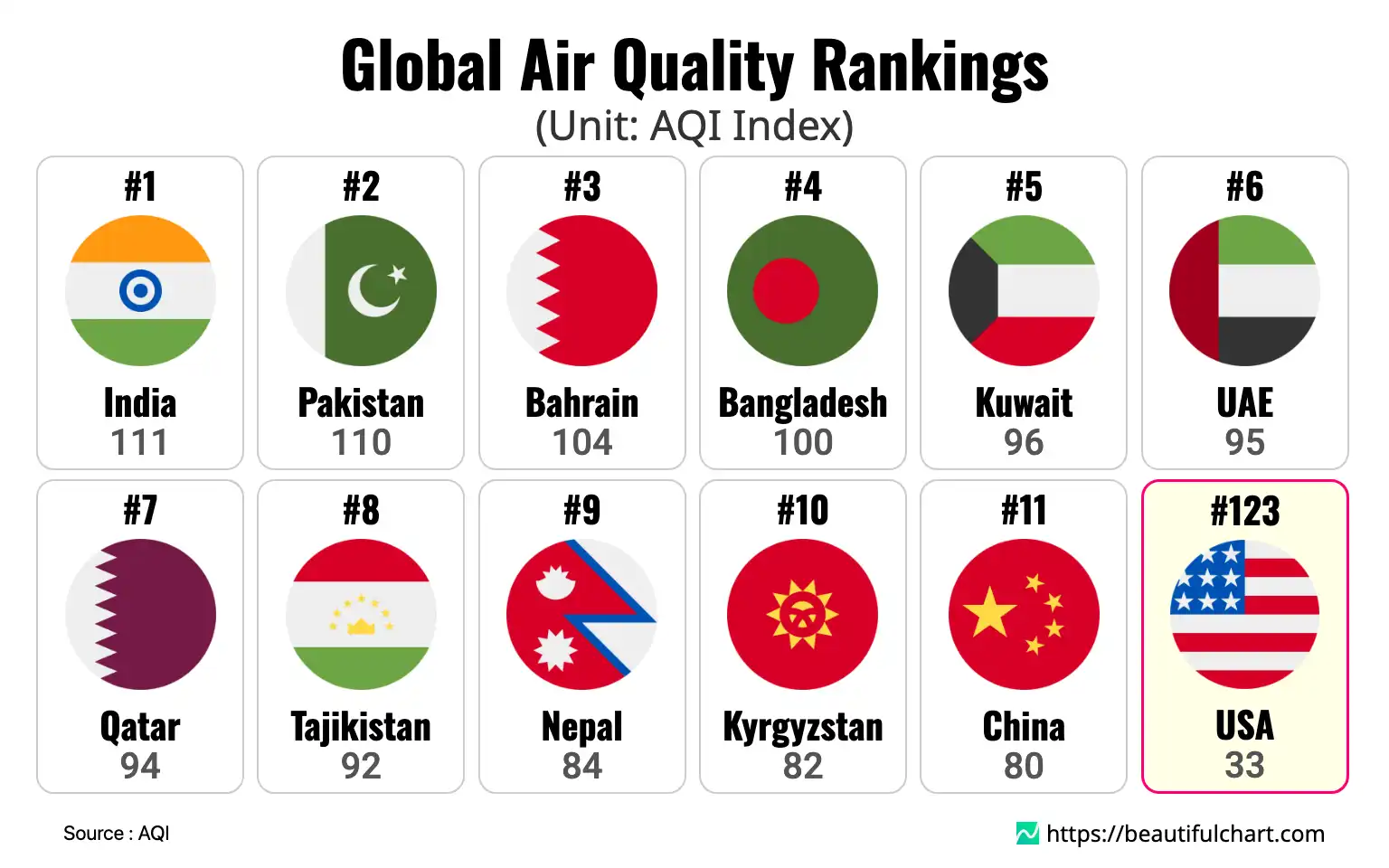
#1 India 111
India currently sits at the top of the list with the highest AQI, reflecting severe air quality challenges. This is largely attributed to a combination of heavy industrial emissions, vehicle exhaust in massive urban centers, and seasonal agricultural fires. The impact on public health in major cities like Delhi is a significant point of concern for both the government and international health organizations.
#2 Pakistan 110
Following closely behind, Pakistan faces similar environmental hurdles. Urban areas like Lahore often experience thick smog during the winter months, caused by industrial output and low-grade fuel use. The high AQI value indicates a persistent risk to the respiratory health of the population, necessitating urgent policy interventions and regional cooperation.
#3 Bahrain 104
Bahrain's ranking is influenced by its unique geographical and industrial profile. As an island nation in an arid region, it is prone to dust and sandstorms which naturally elevate AQI levels. Additionally, the presence of heavy oil and aluminum industries adds to the chemical pollutant load, making air quality a consistent environmental priority for the nation.
#4 Bangladesh 100
With an AQI of exactly 100, Bangladesh struggles with the effects of rapid, dense urbanization. The proliferation of brick kilns around its major cities and the high volume of traffic contribute significantly to the poor air quality. This level of pollution poses a constant challenge for a country striving to balance economic growth with environmental sustainability.
#5 Kuwait 96
Kuwait ranks fifth, driven by its extensive petroleum industry and the natural desert climate. The extraction and processing of oil contribute various pollutants, while frequent sandstorms add particulate matter to the air. The high index level highlights the difficulty of maintaining clean air in a region dominated by fossil fuel production and harsh weather conditions.
#121 USA 33
The United States ranks much lower on the pollution scale, showcasing the effectiveness of long-term environmental regulations. With an AQI of 33, the air quality is generally considered good to moderate. This reflects the impact of cleaner vehicle standards, the transition away from coal-fired power plants, and the implementation of rigorous air quality monitoring and enforcement.
| Rank | Name | Indicator |
|---|---|---|
1 |  India India | 111 |
2 |  Pakistan Pakistan | 110 |
3 |  Bahrain Bahrain | 104 |
4 |  Bangladesh Bangladesh | 100 |
5 |  Kuwait Kuwait | 96 |
6 |  UAE UAE | 95 |
7 |  Qatar Qatar | 94 |
8 |  Tajikistan Tajikistan | 92 |
9 |  Nepal Nepal | 84 |
10 |  Kyrgyzstan Kyrgyzstan | 82 |
11 |  China China | 80 |
11 |  Saudi Arabia Saudi Arabia | 80 |
13 |  Iran Iran | 79 |
14 |  Iraq Iraq | 78 |
15 |  Myanmar Myanmar | 75 |
16 |  Laos Laos | 71 |
16 |  Turkmenistan Turkmenistan | 71 |
18 |  Uganda Uganda | 70 |
19 |  DR Congo DR Congo | 69 |
19 |  Mongolia Mongolia | 69 |


