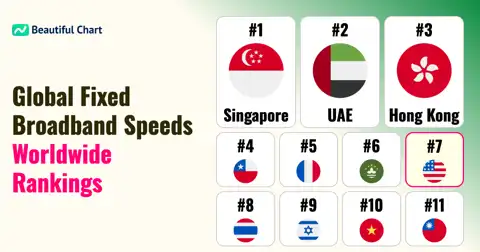
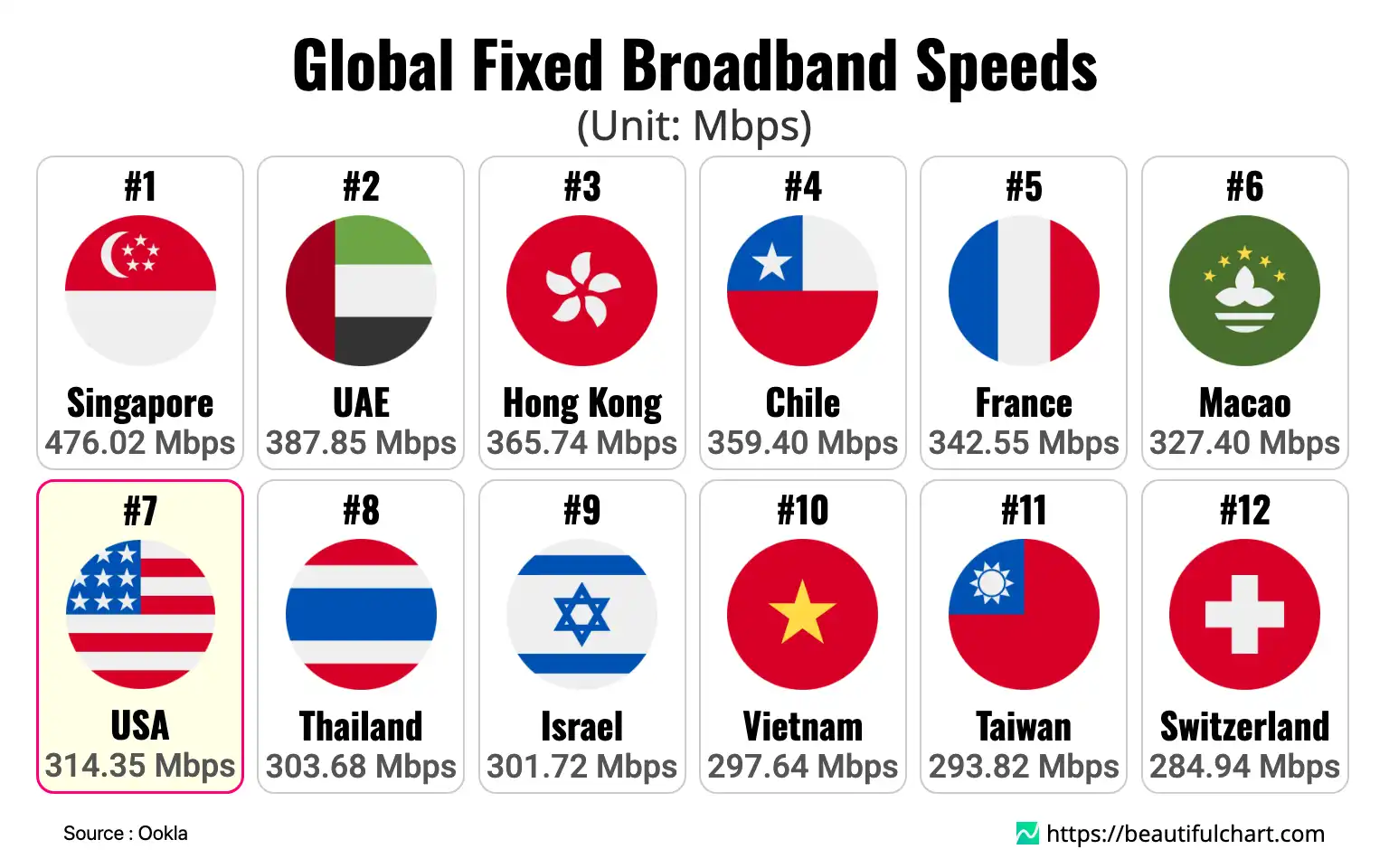
This overview highlights global fixed broadband performance based on Ookla Speedtest median download speeds across numerous countries. Singapore leads the worldwide rankings with an impressive speed approaching 476 Mbps, followed closely by the United Arab Emirates. Meanwhile, the United States secures a strong position within the top tier, showcasing competitive digital infrastructure on an international scale.
Median download speed represents the midpoint of all internet download speed tests conducted by users within a specific country, ensuring that the final metric is not disproportionately skewed by an exceptionally small number of extremely fast or slow connections.
Evaluating global fixed broadband performance provides a clear window into how different nations support increasingly data-intensive digital economies. High-speed wired internet has evolved from a luxury into critical infrastructure, foundational for remote work, cloud computing, high-definition streaming, and emerging technologies like artificial intelligence. Nations leading these rankings typically benefit from aggressive, early investments in nationwide fiber-optic networks, fostering intense competition among telecommunication providers, and supportive regulatory frameworks that encourage infrastructure upgrades.
At the very top of the global spectrum, compact and highly urbanized economies often hold a distinct advantage. Deploying dense fiber networks across smaller geographical areas allows for faster rollout and lower per-capita capital expenditure compared to vast nations with sprawling rural populations. Singapore and the United Arab Emirates exemplify this advantage, utilizing advanced fiber-to-the-home architectures to deliver median download speeds that far exceed the global average. These high speeds ensure seamless connectivity for households and enterprises alike, directly boosting national productivity and digital readiness.
On the other hand, large nations face unique engineering and economic hurdles when attempting to universalize high-speed connectivity. The United States, ranking solidly within the upper tier with speeds exceeding 314 Mbps, demonstrates how substantial private investment combined with targeted government funding can bridge vast geographic distances. However, regional disparities often persist in larger countries, where urban centers enjoy cutting-edge multi-gigabit connections while rural or remote communities rely on legacy cable or hybrid fiber-copper setups. Addressing these connectivity gaps remains a primary focus for policymakers striving to ensure equitable digital access.
Analyzing these international speed metrics also reveals broader economic trends. Countries with robust median download speeds frequently boast thriving tech sectors, advanced educational platforms, and higher rates of digital adoption among citizens. Conversely, nations lingering at the lower end of the index often struggle with outdated infrastructure, limited competition, or structural economic challenges that delay necessary telecom upgrades. As global data demands continue to surge exponentially with the proliferation of smart devices and cloud-dependent workflows, maintaining and expanding high-speed wired infrastructure will remain a top priority for governments worldwide seeking to secure their competitive edge in the modern global market.

Global Fixed Broadband Speeds
This overview highlights global fixed broadband performance based on Ookla Speedtest median download speeds across numerous countries.
Data Source: Ookla
Image Source: Freepik from www.flaticon.com
Key Takeaways
Global Speed Disparities
- Compact urban economies dominate the top tier due to efficient fiber deployment and dense populations.
- The global median download speed highlights a significant gap between technologically advanced regions and developing nations.
- Sustained infrastructure investments are essential for countries aiming to bridge the digital divide.
Impact of Infrastructure
- High-speed wired connections support modern digital economies, remote work, and advanced cloud computing.
- Large nations face unique geographic challenges in delivering uniform high-speed internet to rural and urban populations alike.
- Intense market competition among telecom providers consistently drives faster speeds and better service quality for consumers.
Top Ranking
#1 Singapore 476.02 Mbps
Singapore claims the top spot globally, benefiting from a fully realized, highly dense fiber-optic infrastructure that delivers exceptional median download speeds. This small yet advanced island nation prioritizes digital connectivity as a core pillar of its economic strategy, ensuring ultra-fast and reliable internet access for virtually all residents and businesses.
#2 UAE 387.85 Mbps
The United Arab Emirates secures second place worldwide, driven by aggressive national modernization initiatives and massive investments in advanced telecommunication networks. State-of-the-art fiber deployments across major urban centers allow the country to maintain exceptionally high median download speeds, supporting a rapidly growing digital ecosystem.
#3 Hong Kong 365.74 Mbps
Hong Kong maintains a dominant position in the upper echelons of global internet performance, powered by advanced broadband networks and high-density housing developments. The close proximity of users to fiber distribution nodes enables telecommunication providers to deliver consistently rapid and stable wired connections.
#4 Chile 359.40 Mbps
Chile stands out as a regional leader in Latin America, outperforming many traditional economic powerhouses through proactive regulatory policies and widespread fiber-to-the-home adoption. Continuous market competition has spurred rapid infrastructure upgrades, elevating the country's median download speeds to global competitiveness.
#5 France 342.55 Mbps
France demonstrates strong performance within Europe, anchored by comprehensive national digital plans aimed at deploying high-speed fiber networks to both urban and rural departments. Strategic public-private partnerships have successfully modernized the country's telecommunications backbone, ensuring robust connectivity for millions of households.
#7 USA 314.35 Mbps
The United States secures a strong position in the upper tier of the global index, reflecting substantial ongoing investments in cable, fiber, and emerging broadband technologies. While major metropolitan areas enjoy ultra-fast connectivity, national initiatives continue to focus on expanding high-speed infrastructure to underserved rural communities.
| Rank | Name | Indicator | Subindicator |
|---|---|---|---|
1 |  Singapore | 476.02 Mbps | 374.33 Mbps |
2 |  UAE | 387.85 Mbps | 197.92 Mbps |
3 |  Hong Kong | 365.74 Mbps | 283.81 Mbps |
4 |  Chile | 359.40 Mbps | 280.48 Mbps |
5 |  France | 342.55 Mbps | 268.77 Mbps |
6 |  Macao | 327.40 Mbps | 293.61 Mbps |
7 |  USA | 314.35 Mbps | 72.62 Mbps |
8 |  Thailand | 303.68 Mbps | 248.78 Mbps |
9 |  Israel | 301.72 Mbps | 95.10 Mbps |
10 |  Vietnam | 297.64 Mbps | 253.53 Mbps |
11 |  Taiwan | 293.82 Mbps | 176.54 Mbps |
12 |  Switzerland | 284.94 Mbps | 110.51 Mbps |
13 |  Denmark | 282.61 Mbps | 200.64 Mbps |
14 |  Iceland | 280.47 Mbps | 239.75 Mbps |
15 |  Romania | 277.68 Mbps | 193.63 Mbps |
16 |  Hungary | 273.43 Mbps | 75.97 Mbps |
17 |  Kuwait | 270.55 Mbps | 43.90 Mbps |
18 |  Spain | 266.98 Mbps | 215.43 Mbps |
19 |  Portugal | 260.20 Mbps | 124.65 Mbps |
20 |  Canada | 259.52 Mbps | 97.75 Mbps |