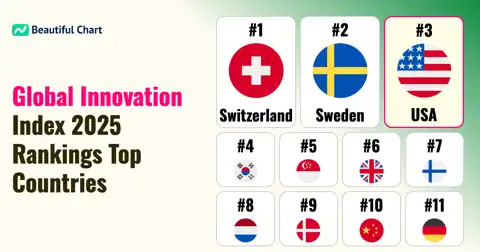
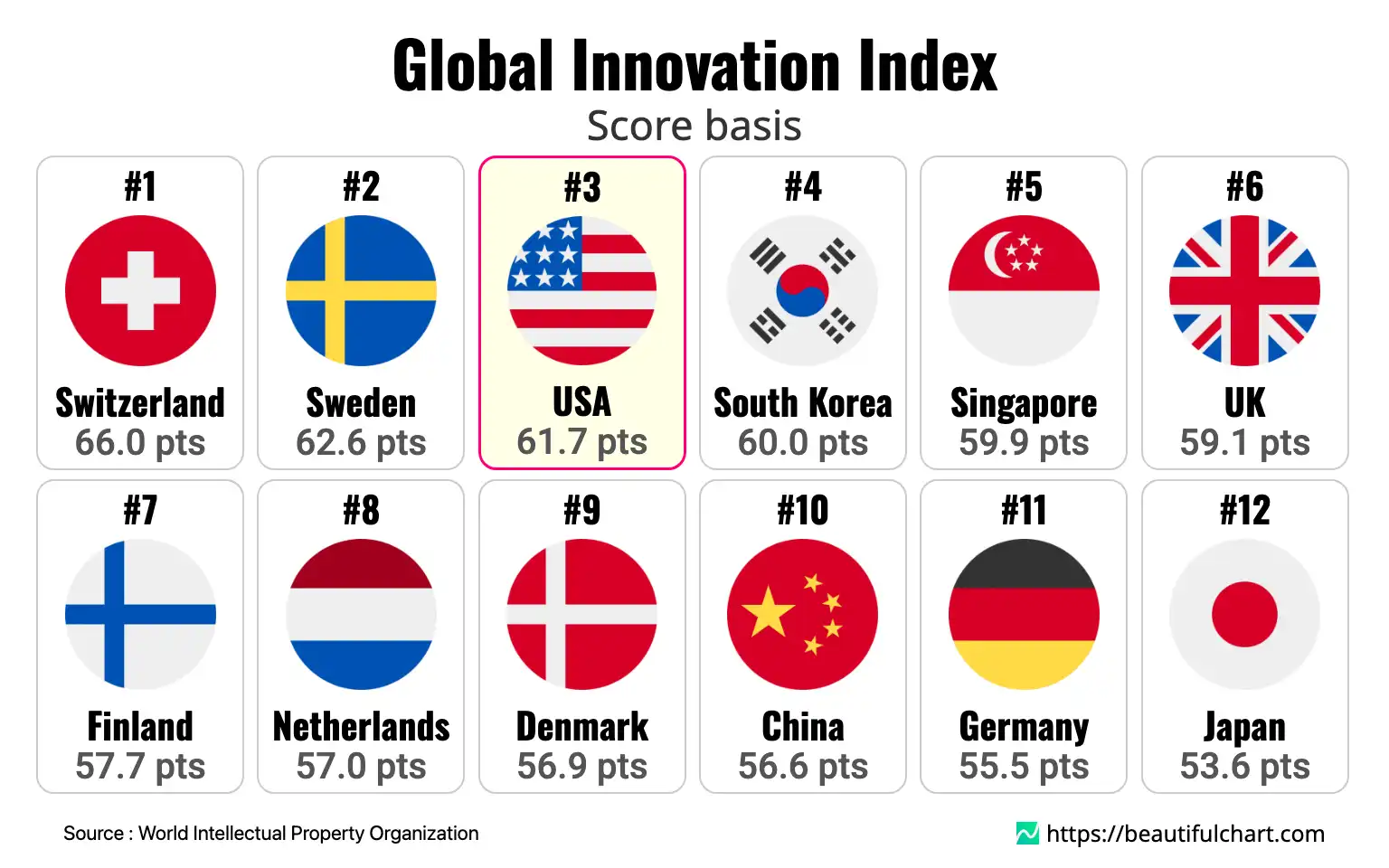
The 2025 Global Innovation Index evaluates 139 economies based on roughly 80 indicators measuring innovation inputs and outputs. Switzerland leads the global rankings with 66.0 points, closely followed by Sweden, the United States, and South Korea, which climbed to fourth place. Meanwhile, China has broken into the top ten for the first time, reflecting shifting technological landscapes worldwide.
The Global Innovation Index is an annual ranking of economies by their capacity for, and success in, innovation, published by the World Intellectual Property Organization. It assesses multiple pillars including institutions, human capital, infrastructure, market sophistication, and knowledge outputs to provide a comprehensive picture of global innovation ecosystems.
Measuring a nation's capacity for innovation requires looking far beyond simple economic output or traditional manufacturing metrics. The evaluation framework encompasses roughly 80 distinct indicators, dividing them broadly into innovation inputs and innovation outputs. Inputs measure the enabling environment for creativity and research, including institutions, human capital, research infrastructure, market sophistication, and business sophistication. Outputs capture the actual tangible results of these investments, such as creative goods and services, online outputs, and knowledge-creation metrics like patents and scientific publications. This dual approach ensures that nations investing heavily in foundational science and supportive ecosystems receive recognition, even if their commercial applications are still maturing.
Switzerland maintains its long-standing dominance at the very pinnacle of the international innovation ecosystem. Consistently securing the top position, the nation benefits from a uniquely robust framework combining high-caliber educational institutions, massive private-sector investment in research and development, and an exceptionally supportive regulatory environment. This environment encourages intellectual property generation and seamless collaboration between academic researchers and multinational corporations. Surrounding European economies also perform remarkably well, utilizing integrated regional networks, strong legal protections for intellectual property, and sustained public funding for advanced technological initiatives.
In North America, the United States secures a formidable position near the absolute top of the global standings, driven by unmatched venture capital availability, world-class research universities, and dynamic private technology enterprises. The American innovation model relies heavily on a vibrant entrepreneurial culture and deep capital markets that readily fund high-risk, high-reward ventures in artificial intelligence, biotechnology, and advanced aerospace engineering. This continuous influx of private capital, coupled with federal backing for foundational sciences, creates a self-sustaining ecosystem that attracts global talent and drives technological frontiers outward.
Asia has emerged as a powerhouse of rapid advancement, most notably demonstrated by South Korea rising to the fourth position and China breaking into the top ten economies for the first time. South Korea's ascent is anchored by aggressive, sustained investments in research and development relative to its economic size, alongside massive industrial commitments to semiconductors, digital infrastructure, and advanced manufacturing. China's historic entry into the top tier underscores a decades-long strategic focus on scaling up domestic technological capabilities, increasing patent filings, and fostering indigenous high-tech industries. These shifts illustrate how targeted national policies, combined with robust educational systems focused on science, technology, engineering, and mathematics, can fundamentally alter global technological leadership over relatively short periods.

Global Innovation Index 2025 Rankings
The 2025 Global Innovation Index evaluates 139 economies based on roughly 80 indicators measuring innovation inputs and outputs.
Data Source: World Intellectual Property Organization
Image Source: Freepik from www.flaticon.com
Key Takeaways
Evaluation Methodology and Structure
- Assesses approximately 80 indicators grouped into innovation inputs and outputs.
- Measures enabling environments like institutions, human capital, and infrastructure.
- Captures tangible results including knowledge creation, creative goods, and technological outputs.
European Leadership and Stability
- Switzerland maintains the top position globally through strong institutional support and R&D investment.
- European economies benefit from integrated regional networks and robust legal frameworks.
- Sustained public and private funding creates stable, long-term innovation ecosystems.
Shifts in Asian and North American Markets
- The United States remains near the top due to venture capital availability and elite research institutions.
- South Korea climbs to fourth place through intensive research commitments and semiconductor leadership.
- China enters the top ten for the first time, reflecting massive scaling of domestic technological capabilities.
Top Ranking
#1 Switzerland 66.0 pts
Switzerland claims the top position in the global innovation rankings with a score of 66.0 points. The nation's success stems from a world-class educational system, heavy private-sector investments in research and development, and an exceptionally supportive business environment that fosters intellectual property generation.
#2 Sweden 62.6 pts
Sweden secures second place globally with a score of 62.6 points. The country excels through strong public-private partnerships, a highly digitized economy, and consistent support for technological advancement and sustainable innovation frameworks.
#3 USA 61.7 pts
Ranking third with 61.7 points, the United States benefits from unmatched venture capital networks, elite research universities, and a dynamic private sector that constantly pioneers breakthroughs in artificial intelligence, biotechnology, and digital platforms.
#4 South Korea 60.0 pts
South Korea climbs to fourth place with a score of 60.0 points. The nation's high standing is driven by aggressive investments in research and development, advanced manufacturing capabilities, and a strong focus on digital infrastructure and high-tech industries.
#5 Singapore 59.9 pts
Singapore places fifth globally with 59.9 points, standing out for its strategic geographical position, highly efficient regulatory frameworks, business-friendly policies, and robust investments in smart city technologies and high-value manufacturing.
| Rank | Name | Indicator | Subindicator |
|---|---|---|---|
1 |  Switzerland | 66.0 pts | Rank - 1 |
2 |  Sweden | 62.6 pts | Ranks - 2 |
3 |  USA | 61.7 pts | Ranks - 3 |
4 |  South Korea | 60.0 pts | Ranks - 4 |
5 |  Singapore | 59.9 pts | Ranks - 5 |
6 |  UK | 59.1 pts | Ranks - 6 |
7 |  Finland | 57.7 pts | Ranks - 7 |
8 |  Netherlands | 57.0 pts | Ranks - 8 |
9 |  Denmark | 56.9 pts | Ranks - 9 |
10 |  China | 56.6 pts | Ranks - 10 |
11 |  Germany | 55.5 pts | Ranks - 11 |
12 |  Japan | 53.6 pts | Ranks - 12 |
13 |  France | 53.4 pts | Ranks - 13 |
14 |  Israel | 52.3 pts | Ranks - 14 |
15 |  Hong Kong | 51.5 pts | Ranks - 15 |
16 |  Estonia | 51.1 pts | Ranks - 16 |
16 |  Canada | 51.1 pts | Ranks - 16 |
18 |  Ireland | 50.4 pts | Ranks - 18 |
19 |  Austria | 50.1 pts | Ranks - 19 |
20 |  Norway | 49.2 pts | Ranks - 20 |