
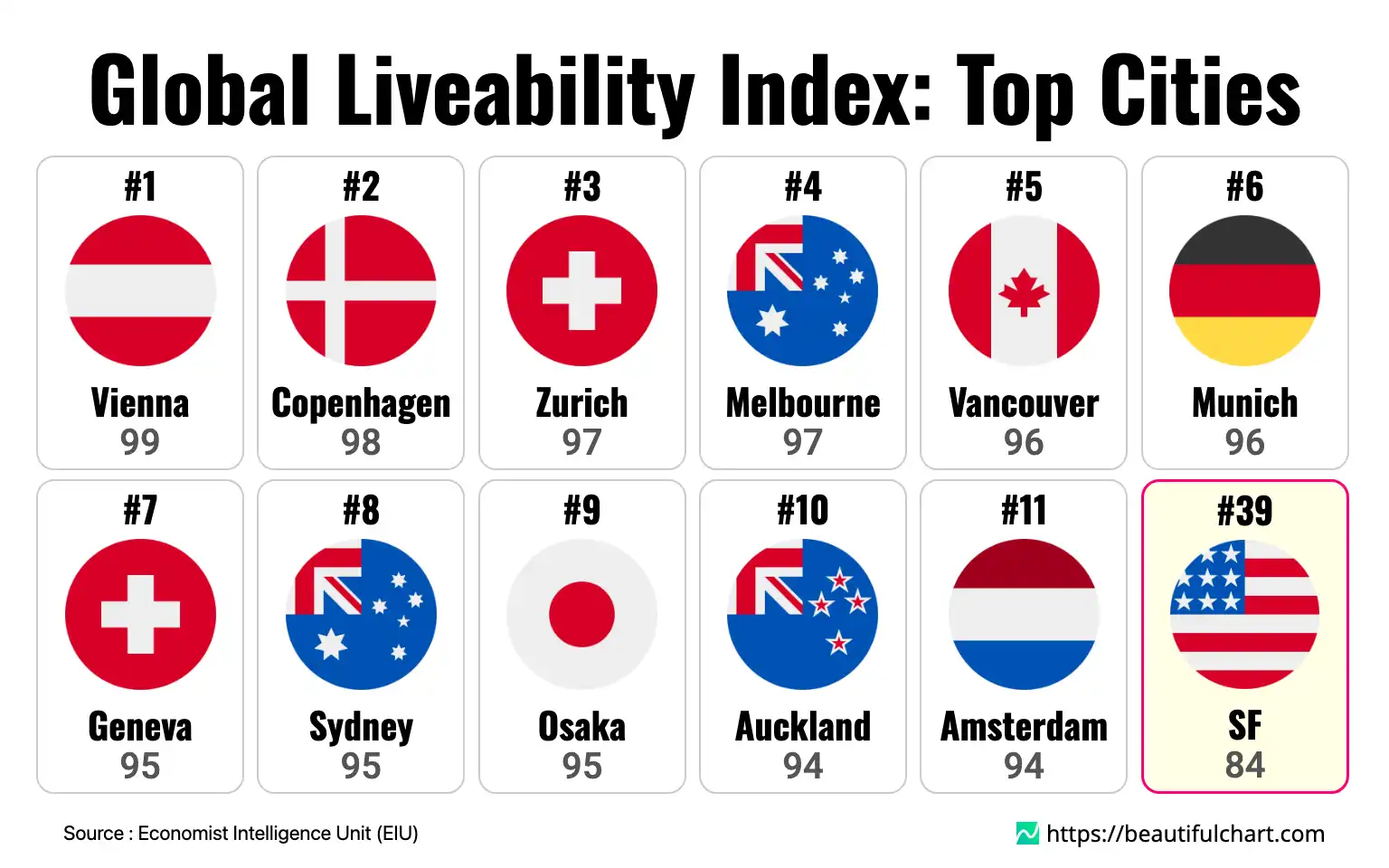
This ranking highlights the leading urban centers worldwide where economic opportunity and social well-being intersect to create the highest quality of life. The data showcases a significant dominance of European and Oceanian cities in the top tiers, reflecting superior infrastructure and social stability. By comparing these scores, professionals and families can identify which global hubs offer the best balance of safety, healthcare, and career growth.
The Econ-Social Index is a comprehensive metric used to evaluate the quality of life in urban areas by aggregating data on economic stability, healthcare access, cultural vibrancy, environmental quality, and infrastructure. It provides a holistic score that determines how well a city supports the overall well-being and prosperity of its residents.
Understanding what makes a city truly livable has become a priority for global citizens, especially those in their prime career years looking for a balance between professional success and personal fulfillment. When we look at the leaders in urban excellence, it is impossible to ignore the persistent success of Central European and Scandinavian models. Vienna and Copenhagen have essentially cracked the code on urban harmony, blending centuries of cultural heritage with cutting-edge public services. These cities don't just provide a place to work; they offer an environment where the daily commute is stress-free, and green spaces are a right rather than a luxury.
Actually, the result for the Asia-Pacific region is quite surprising in its consistency. Melbourne and Sydney continue to represent the gold standard for the Southern Hemisphere, offering a lifestyle that many Western professionals envy. The combination of high-quality education systems and a climate that encourages an active lifestyle remains a massive draw. Meanwhile, in East Asia, cities like Osaka and Tokyo prove that extreme density doesn't have to mean a sacrifice in livability. Their scores are bolstered by world-class safety and public transportation systems that operate with surgical precision, though the social pressure of these high-efficiency environments remains a point of discussion for those moving from the West.
Turning our focus to North America, particularly the United States, we see a very different story. San Francisco and New York both landing at rank 38 might seem low to some, but it reflects a complex trade-off. These cities are arguably the most powerful economic engines on the planet. If you are looking for career peak and innovation, San Francisco is unbeatable. However, the Econ-Social Index takes a holistic view. High costs of living, aging infrastructure, and social disparities in major US hubs act as a weight on their overall scores when compared to the highly subsidized social systems of Europe. For a professional in his 40s, a move to San Francisco might mean a higher salary, but it often comes with a significant jump in housing costs and a different set of social challenges than one would find in Munich or Zurich.
Further down the list, we see the rise of secondary hubs and the struggle of mega-cities in developing regions. The gap between the top 20 and the bottom 20 is largely defined by stability and infrastructure. Cities like Seoul and Singapore are hovering just outside the top tier, which is fascinating because they often lead in technological infrastructure but are slightly tempered by the high cost of urban living and work-life balance metrics.
Ultimately, the trend we are seeing is a shift toward 'human-centric' urban planning. The cities that are climbing the ranks are those that prioritize the pedestrian over the car, the patient over the profit, and the citizen's peace of mind over raw industrial output. It’s no longer enough for a city to be a financial hub; it must also be a sanctuary. This is why we see smaller, highly organized European cities consistently outperforming the massive, sprawling metropolises of the Americas and Asia in pure livability terms. It serves as a reminder that the best place to live is often where the city works for you, rather than you working for the city.

Top 100 Most Livable Cities
This ranking highlights the leading urban centers worldwide where economic opportunity and social well-being intersect to create the highest quality of life.
Data Source: Economist Intelligence Unit (EIU)
Image Source: Freepik from www.flaticon.com
Key Takeaways
European Urban Excellence
- European cities like Vienna, Copenhagen, and Zurich dominate the top of the list due to exceptional social safety nets and infrastructure.
- Germany specifically shows strong performance with multiple cities like Munich and Berlin ranking high for stability and cultural wealth.
- The 'human-scale' design of these cities contributes to higher happiness and lower stress levels among residents.
The Asia-Pacific Balance
- Melbourne and Sydney remain the top choices in the region, offering a high-tier blend of natural beauty and economic opportunity.
- Osaka and Tokyo showcase how high-density Asian cities can maintain top-tier safety and public service standards.
- Emerging hubs in Southeast Asia are slowly improving but still face challenges in infrastructure and environmental quality compared to their northern neighbors.
North American Economic Trade-offs
- Major US cities like San Francisco and New York provide unmatched economic opportunities but suffer in livability rankings due to high costs and social inequality.
- Canadian cities like Vancouver and Toronto consistently outrank their US counterparts by offering better healthcare and social stability.
- For professionals, the choice often comes down to choosing between maximum career growth in the US or a more balanced lifestyle in Canada or Europe.
Top Ranking
#1 Vienna 99
Vienna continues its reign as the world's most livable city. Its success is rooted in a unique combination of affordable social housing, a majestic cultural scene, and an public transport system that is both cheap and incredibly efficient. For residents, the city offers a sense of security and a pace of life that is rare for a national capital.
#2 Copenhagen 98
Copenhagen is the global leader in sustainable urban living. Known for its pervasive bicycle culture and focus on green energy, the city provides a healthy and environmentally conscious lifestyle. High levels of social equality and trust in government make it one of the happiest places to live and work.
#3 Zürich 97
As a global hub for finance and innovation, Zürich offers unparalleled economic stability and high salaries. Beyond the workplace, the city is praised for its cleanliness, stunning natural surroundings, and a highly reliable healthcare system that justifies its high cost of living.
#3 Melbourne 97
Melbourne remains a top contender by offering a vibrant multicultural atmosphere and world-class education. Its high score is driven by its healthcare infrastructure and a thriving arts and coffee culture that makes it one of the most attractive destinations in the Southern Hemisphere.
#5 Vancouver 96
Vancouver is celebrated for its breathtaking natural landscape, providing residents with easy access to both the ocean and the mountains. It serves as a key gateway for trade and attracts a diverse international population, though it faces ongoing challenges regarding housing affordability.
#5 Munich 96
Munich offers a perfect blend of high-tech industry and traditional Bavarian charm. It is one of the safest major cities in the world and boasts extensive park systems, including the famous English Garden, making it an ideal location for families and professionals alike.
#38 San Francisco 84
San Francisco remains the heart of the global technology industry, offering some of the highest career potential in the world. While its innovation and natural beauty are significant draws, its ranking is impacted by extreme housing costs and visible social challenges in the urban core.
| Rank | Name | Indicator |
|---|---|---|
1 |  Vienna Vienna | 99 |
2 |  Copenhagen Copenhagen | 98 |
3 |  Zurich Zurich | 97 |
3 |  Melbourne Melbourne | 97 |
5 |  Vancouver Vancouver | 96 |
5 |  Munich Munich | 96 |
7 | Geneva | 95 |
7 | Sydney | 95 |
7 |  Osaka Osaka | 95 |
10 |  Auckland Auckland | 94 |
10 |  Amsterdam Amsterdam | 94 |
10 | France | 94 |
13 | Toronto | 93 |
13 | Berlin | 93 |
13 |  Stockholm Stockholm | 93 |
16 |  Luxembourg Luxembourg | 92 |
16 |  Helsinki Helsinki | 92 |
16 |  Singapore Singapore | 92 |
19 |  Oslo Oslo | 91 |
19 | Tokyo | 91 |


