When observing the global economic landscape over the past few decades, the stark contrasts in GDP per capita growth become immediately apparent. A select group of developing nations has managed to achieve staggering economic multiples, completely transforming their national wealth. Interestingly, while smaller economies dominate the highest growth rankings, major powers like the United States still maintain significant and steady economic expansion. This visual representation highlights the shifting dynamics of global wealth distribution and the remarkable rise of emerging markets.
GDP per capita is a financial metric that breaks down a country's economic output per person, calculated by dividing the gross domestic product by the total population. It serves as a widely used indicator of a nation's standard of living and overall economic health. A higher growth ratio in this metric signifies that the average wealth and productivity of the citizens are increasing over time.
The Phenomenon of Explosive Economic Expansion
The economic landscape of the world has undergone a profound transformation, with wealth generation accelerating at unprecedented rates in specific regions. When examining the variations in GDP per capita growth, it becomes evident that smaller, resource-rich, or strategically positioned nations have experienced exponential wealth multiplication. This is not merely a statistical anomaly but a reflection of globalization, technological advancement, and targeted economic policies that have allowed previously underdeveloped nations to integrate into the global market. The sheer magnitude of the growth ratios, some exceeding thousands of percent, illustrates how rapidly a nation's standard of living can evolve when the right economic catalysts are present.
Resource Wealth and Strategic Development
A significant pattern emerges among the nations exhibiting the highest growth multiples. Countries possessing vast natural resources, particularly oil and natural gas, have been able to leverage these assets to multiply their national wealth. Equatorial Guinea stands out as a prime example, where the discovery and extraction of substantial oil reserves fundamentally altered its economic trajectory, resulting in a staggering growth ratio. Similarly, nations that have successfully positioned themselves as global financial hubs or tourism destinations, such as the Maldives and Ireland, have attracted massive foreign investment. Ireland's strategic corporate tax policies, for instance, have drawn major multinational corporations, dramatically inflating its GDP per capita.
The Asian Economic Miracle
The data also vividly illustrates the extraordinary economic rise of Asia. China's transition from an agrarian society to the world's manufacturing powerhouse has resulted in one of the most remarkable wealth creation events in human history. This massive industrialization and integration into global supply chains have lifted hundreds of millions out of poverty, reflected in a growth multiple that rivals the fastest-growing micro-economies. Alongside China, nations like Singapore and South Korea have transitioned into advanced, high-tech economies through heavy investment in education, innovation, and export-driven manufacturing. These economies demonstrate that sustained, policy-driven growth can yield exponential increases in per capita wealth without relying solely on natural resources.
The Sustained Growth of Developed Nations
While the most dramatic growth ratios belong to developing or transitioning economies, the performance of established global powers remains a critical component of the economic narrative. The United States, despite starting from a much higher baseline of wealth, has maintained a robust and consistent growth trajectory. Unlike emerging markets that benefit from rapid industrialization, the US economic expansion has been largely driven by continuous technological innovation, a resilient consumer market, and dominance in global financial systems. The ability of the United States to multiply its GDP per capita while already holding the position as a massive, developed economy underscores the enduring strength and adaptability of its economic model.
Implications for the Global Future
The stark variations in wealth accumulation highlight a rapidly shifting global balance of power. As emerging markets continue to grow at multiples far exceeding those of legacy economies, the concentration of global wealth is diversifying. However, it is crucial to recognize that a high growth ratio does not always equate to equitable wealth distribution within a nation. In many resource-dependent countries, the exponential increase in GDP per capita may mask underlying income inequality. Moving forward, the true measure of economic success will not merely be the multiplication of national output, but the sustainable and inclusive distribution of that wealth to improve the fundamental quality of life for all citizens.

Global GDP Per Capita Growth Analysis
When observing the global economic landscape over the past few decades, the stark contrasts in GDP per capita growth become immediately apparent.
Data Source: IMF
Key Takeaways
The Rise of Resource and Strategic Economies
- The most dramatic increases in national wealth are often triggered by the sudden discovery and exploitation of valuable natural resources.
- Small island nations and strategically located countries have successfully leveraged tourism and foreign corporate investment to multiply their economic output.
- These rapid economic transformations highlight how globalization allows developing nations to quickly integrate into the broader market.
Asian Industrialization and Innovation
- The transition of Asian countries from agrarian societies to industrial and technological powerhouses represents a major shift in global wealth.
- Massive investments in export-driven manufacturing and education have allowed these nations to sustain high growth over extended periods.
- This consistent policy-driven expansion proves that immense wealth creation is possible without relying entirely on raw material exports.
The Resilience of Established Economic Powers
- Despite having a massive initial baseline, established economies like the United States have continued to experience significant wealth multiplication.
- This sustained growth in developed nations is primarily fueled by technological advancements, financial sector dominance, and strong consumer markets.
- The ability of major powers to maintain steady growth while emerging markets surge demonstrates the diverse pathways to economic prosperity.
Top Ranking
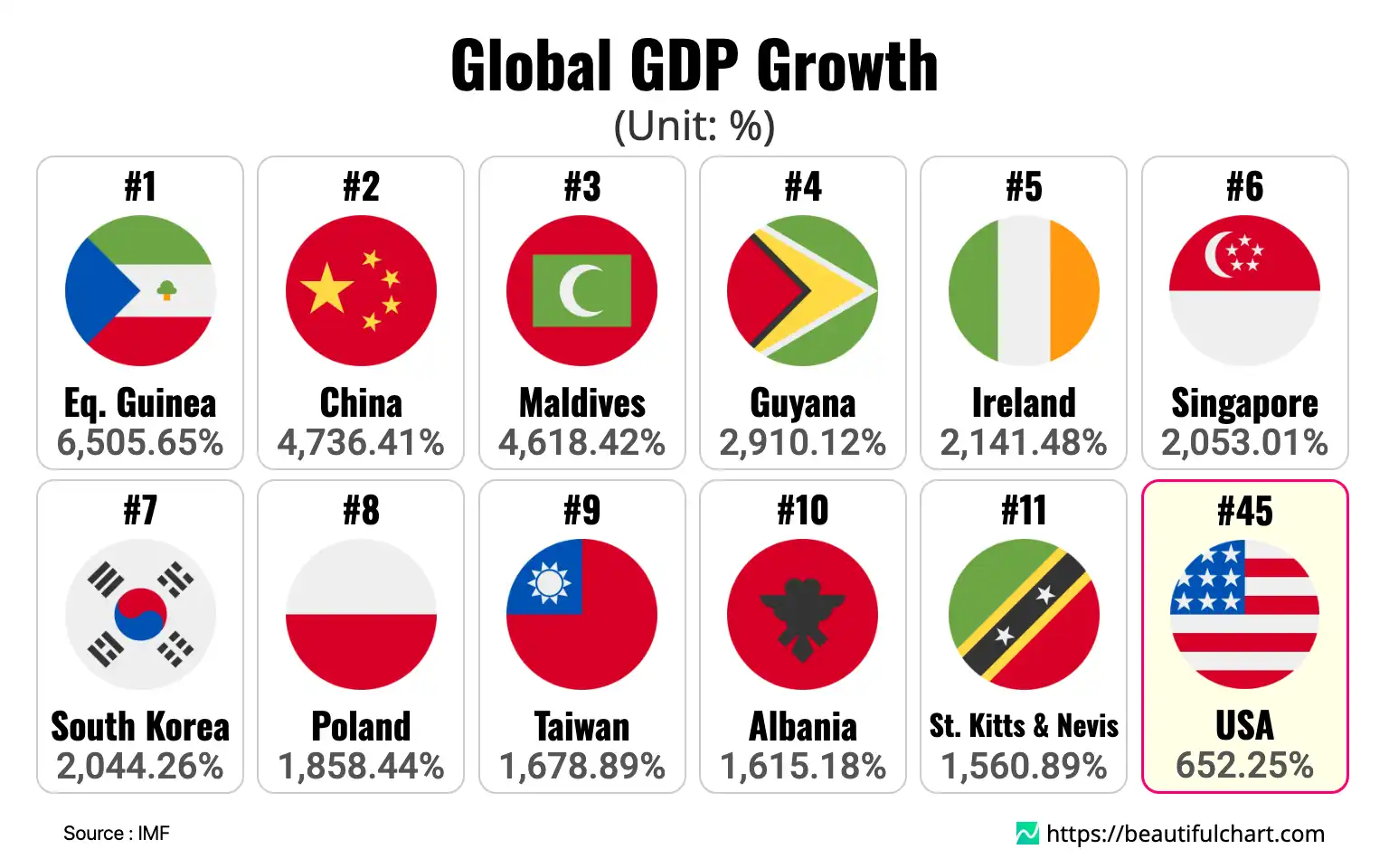
#1 Eq. Guinea 65.0565
Equatorial Guinea experienced an unprecedented explosion in wealth primarily driven by the discovery of massive offshore oil reserves. This rapid transition from a modest agricultural economy to a major energy exporter resulted in the highest wealth multiplication globally. However, the immense surge in national output also brings challenges regarding wealth distribution and long-term economic diversification.
#2 China 47.3641
China's remarkable economic expansion is the result of its historic opening to global markets and massive industrialization efforts. By becoming the world's primary manufacturing hub and heavily investing in infrastructure, the nation has achieved a wealth growth multiple that is nearly unmatched for a country of its massive size and population.
#3 Maldives 46.1842
The Maldives has successfully transformed its economy by capitalizing on its unique geographical beauty to build a world-class luxury tourism industry. This strategic focus has attracted substantial foreign investment and revenue, allowing the small island nation to multiply its per capita wealth exponentially despite having limited natural resources.
#4 Guyana 29.1012
Guyana has seen a dramatic economic shift following recent and significant offshore oil discoveries, completely altering its financial landscape. As these energy resources are developed and exported, the nation's per capita wealth has surged rapidly, positioning it as one of the fastest-growing economies in the world.
#5 Ireland 21.4148
Ireland's impressive economic growth is largely attributed to its highly strategic corporate tax policies and business-friendly environment. By successfully attracting the European headquarters of major multinational technology and pharmaceutical companies, Ireland has dramatically inflated its domestic output and multiplied its per capita wealth.
#45 USA 6.5225
The United States demonstrates remarkable economic resilience and sustained growth despite starting from an already highly developed baseline. This steady multiplication of wealth is driven by relentless technological innovation, a dynamic consumer market, and its enduring status as the center of the global financial system.
| Rank | Name | Indicator | Subindicator |
|---|---|---|---|
1 |  Eq. Guinea | 6505.65% | 1980 : $ 123 |
2 |  China | 4736.41% | 1980 : $ 308 |
3 |  Maldives | 4618.42% | 1980 : $ 413 |
4 |  Guyana | 2910.12% | 1980 : $ 1,102 |
5 |  Ireland | 2141.48% | 1980 : $ 6,254 |
6 |  Singapore | 2053.01% | 1980 : $ 5,005 |
7 |  South Korea | 2044.26% | 1980 : $ 1,745 |
8 |  Poland | 1858.44% | 1980 : $ 1,600 |
9 |  Taiwan | 1678.89% | 1980 : $ 2,367 |
10 |  Albania | 1615.18% | 1980 : $ 728 |
11 |  St. Kitts & Nevis | 1560.89% | 1980 : $ 1,333 |
12 |  Bhutan | 1467.25% | 1980 : $ 311 |
13 |  Hungary | 1217.13% | 1980 : $ 2,159 |
14 |  Romania | 1152.04% | 1980 : $ 2,052 |
15 |  St. Vincent & Gren. | 1128.43% | 1980 : $ 903 |
16 |  Cape Verde | 1071.83% | 1980 : $ 569 |
17 |  Antigua & Barbuda | 1059.97% | 1980 : $ 1,935 |
18 |  Thailand | 1048.87% | 1980 : $ 705 |
19 |  Israel | 992.53% | 1980 : $ 6,389 |
20 |  Panama | 983.90% | 1980 : $ 1,897 |