The performance of national teams in the prestigious international football tournament can be deeply analyzed through their offensive capabilities. This overview presents the expected goals (xG) accumulated by each participating country throughout the competition, highlighting the most threatening attacking sides. The United States, despite a respectable showing, demonstrates a distinct contrast in chance creation compared to the dominant European and South American powerhouses. The figures offer a clear reflection of which teams consistently penetrated opposition defenses and engineered high-quality scoring opportunities.
Expected Goals (xG) is a statistical metric used in football to evaluate the quality of a scoring opportunity. It calculates the probability of a shot resulting in a goal based on historical data, considering factors like distance, angle, and the type of assist provided.
The expected goals (xG) metric provides a comprehensive evaluation of a team's offensive efficiency by quantifying the quality of scoring opportunities generated during matches. Analyzing the data from this major international tournament reveals a distinct hierarchy in attacking prowess, with traditional footballing powerhouses dominating the upper echelons of the rankings. The correlation between high offensive metrics and deep progression in the tournament is generally strong, although notable exceptions exist where defensive frailties or specific match dynamics altered outcomes.
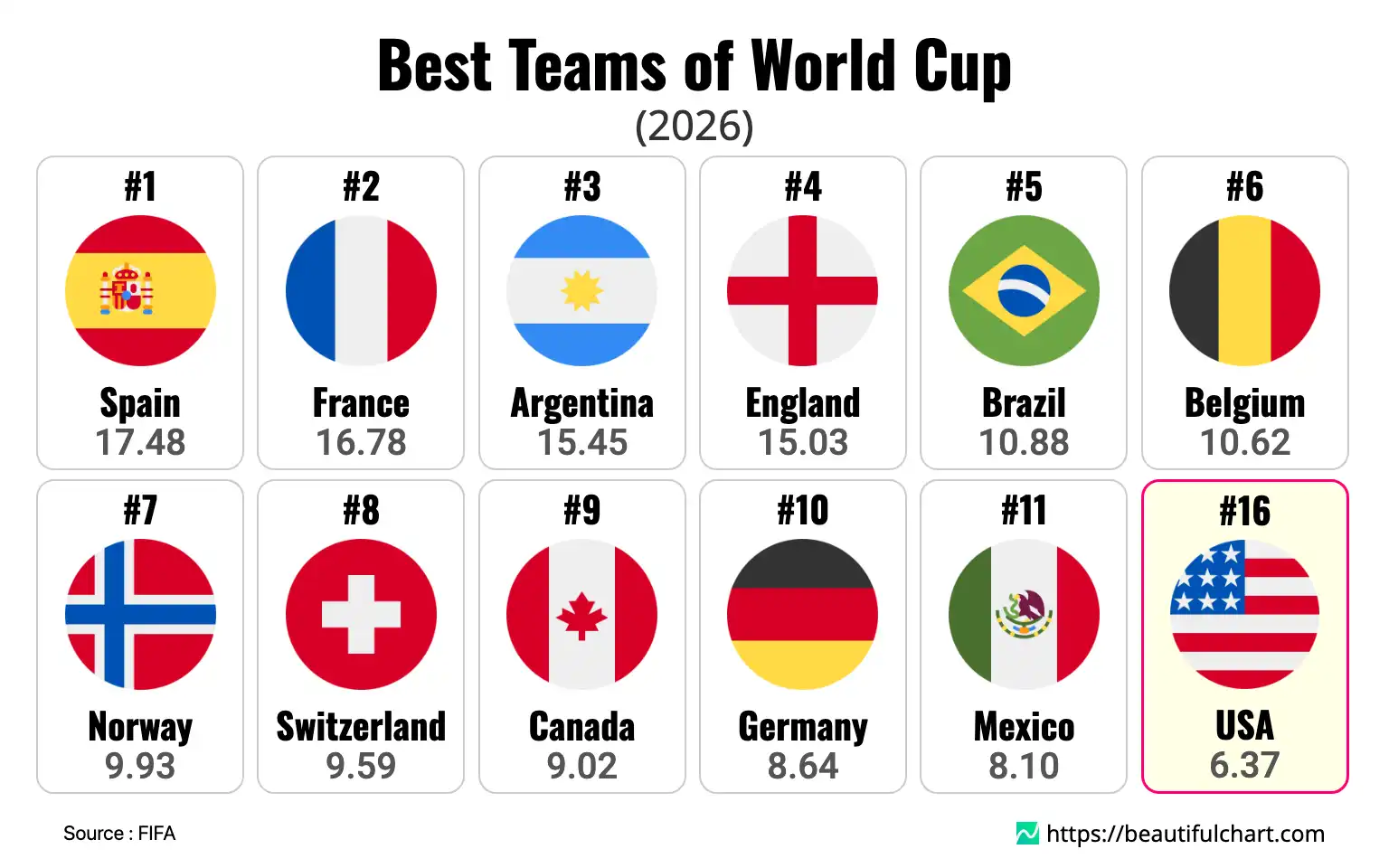
Spain, securing the championship title, also recorded the highest expected goals tally with 17.48. This figure is indicative of an offensive structure that consistently breached opposing defensive lines to create high-probability scoring chances. The data suggests that their tactical approach, focused on controlling possession in advanced areas, was highly effective in sustaining attacking pressure throughout their campaign.
France accumulated 16.78 expected goals, ranking second overall despite finishing fourth in the tournament standings. This high volume of chance creation points to a dynamic attacking system that consistently threatened opponents. The discrepancy between their high xG and final placement implies that while their forward line generated numerous opportunities, factors such as finishing efficiency or opposition defensive resilience in critical moments may have impacted their ultimate success. Argentina and England followed closely with 15.45 and 15.03 expected goals, respectively. Both nations demonstrated consistent offensive output, which supported their runs to the final and third-place matches.
Regional Performance Disparities
The data highlights a significant concentration of high offensive output among European and South American nations. Brazil, for instance, generated 10.88 expected goals despite their campaign ending in the Round of 16 following a defeat by France. Accumulating such a high figure in a reduced number of matches underscores a potent attacking philosophy that remained effective even in the face of early elimination. This trend among the top-ranked teams illustrates a high standard of tactical execution in the final third that sets them apart from the rest of the participating nations.
Evaluation of the United States
The United States recorded a total of 6.37 expected goals, positioning them lower in the overall rankings. Their tournament concluded in the Round of 16 against Norway. The data reflects a moderate level of offensive production, suggesting that while the team was capable of engineering scoring opportunities, they struggled to replicate the sustained volume and high quality of chances seen from the leading nations. This disparity indicates an area for tactical development, particularly in breaking down organized defensive structures to increase the frequency of high-probability scoring events. Comparing their output to the tournament leaders provides a clear quantifiable benchmark for evaluating their attacking efficiency on the global stage.

2026 World Cup Final Team xG Rankings
The performance of national teams in the prestigious international football tournament can be deeply analyzed through their offensive capabilities.
Data Source: FIFA
Image Source: Freepik from www.flaticon.com
Key Takeaways
Dominance of the Finalists
- Spain's tournament victory was supported by their superior offensive chance creation and sustained pressure.
- Argentina and England demonstrated highly effective attacking systems to secure their high finishes.
- The correlation between high expected goals and deep tournament runs is clearly evident among the leaders.
High Output Despite Early Exits
- France recorded the second-highest offensive metrics despite falling short of the final match.
- Brazil maintained an elite level of chance creation even though they were eliminated in the Round of 16.
- Generating scoring opportunities does not always guarantee advancement if other factors intervene.
Performance of the United States
- The United States managed a moderate offensive output that fell behind the tournament leaders.
- Their Round of 16 exit aligns with an attacking performance that struggled to break down elite defenses.
- Increasing the volume of high-quality chances remains a clear benchmark for their future tactical development.
Top Ranking
#1 Spain 17.48
Spain led the tournament in offensive production, perfectly aligning with their ultimate championship victory. Their intricate passing networks and positional rotations allowed them to consistently penetrate opposition penalty areas, resulting in the highest quality of scoring opportunities throughout the competition.
#2 France 16.78
Despite finishing fourth overall, France showcased a relentless and potent attacking force. Their ability to generate such a high volume of expected goals highlights individual brilliance and a dynamic tactical setup that constantly kept opposing defenders on the back foot during their campaign.
#3 Argentina 15.45
The runners-up demonstrated a highly effective and balanced offensive strategy. Their attacking metrics reflect a team capable of breaking down deeply entrenched defenses through both structured build-up play and moments of individual exceptionalism, cementing their status as a global football powerhouse.
#4 England 15.03
Securing a third-place finish, England's attacking output closely mirrored the other top nations. Their tactical approach successfully engineered a significant number of high-quality chances, showcasing a versatile forward line that could adapt to various defensive challenges presented during the tournament.
#5 Brazil 10.88
Even with a disappointing Round of 16 exit, Brazil's offensive machinery was undeniably elite. Their high metric accumulation in fewer matches underscores their traditional attacking flair and the sheer volume of threats they posed whenever they possessed the ball in the final third.
#16 USA 6.37
The United States displayed a moderate level of offensive creation before their Round of 16 elimination. While showing organized attacking phases, their output highlights a clear gap in consistent high-quality chance generation when compared to the dominant European and South American squads.
| Rank | Name | Indicator | Subindicator |
|---|---|---|---|
1 |  Spain | 17.48 | Goals - 14 |
2 |  France | 16.78 | Goals - 20 |
3 |  Argentina | 15.45 | Goals - 19 |
4 |  England | 15.03 | Goals - 20 |
5 |  Brazil | 10.88 | Goals - 10 |
6 |  Belgium | 10.62 | Goals - 14 |
7 |  Norway | 9.93 | Goals - 13 |
8 |  Switzerland | 9.59 | Goals - 10 |
9 |  Canada | 9.02 | Goals - 9 |
10 |  Germany | 8.64 | Goals - 11 |
11 |  Mexico | 8.10 | Goals - 10 |
12 |  Colombia | 7.32 | Goals - 5 |
13 |  Senegal | 7.22 | Goals - 10 |
14 |  Morocco | 6.57 | Goals - 10 |
15 |  Portugal | 6.39 | Goals - 8 |
16 |  USA | 6.37 | Goals - 11 |
17 |  Ecuador | 5.88 | Goals - 2 |
18 |  Egypt | 5.75 | Goals - 8 |
19 |  Ivory Coast | 5.50 | Goals - 5 |
19 |  Turkey | 5.50 | Goals - 3 |