The semi-finals of the tournament brought incredible moments of individual brilliance and playmaking ability. We saw teams rely heavily on their creative engines to break down stubborn defenses and secure a spot in the ultimate match. American audiences, alongside the rest of the world, witnessed a masterclass in tactical execution and individual flair. Here is a deep dive into the creative forces that shaped these crucial matches.
Playmaker - A player who controls the flow of the team's offensive play, often involved in passing moves which lead to goals, relying on vision, technique, and spatial awareness.
The stage was set for the semi-finals, and the tension was palpable as four footballing giants clashed for a spot in the ultimate showdown. The creativity rankings from these matches offer a fascinating glimpse into how individual brilliance can dismantle even the most organized defensive units. When you look closely at the numbers, it becomes clear that playmaking ability is not just about flashy moves; it is about recognizing patterns, exploiting fleeting gaps, and executing under unimaginable pressure.
Spain's Masterclass in Control
The encounter between France and Spain was a testament to the power of proactive football. From the opening whistle, Spain asserted their dominance through high pressing and fluid passing. They did not just wait for opportunities; they manufactured them. The early breakthrough came when Lamine Yamal, showcasing immense creative flair on the flank, drew a crucial foul inside the penalty area. Mikel Oyarzabal's resulting penalty conversion was the reward for Spain's collective offensive pressure.
France, on the other hand, found themselves suffocated. The Spanish midfield, featuring highly-ranked creative forces like Dani Olmo and Fabián Ruiz, dictated the rhythm entirely. France struggled to string passes together, their usual attacking rhythm completely disrupted. Even when France attempted to shift the dynamic in the second half by introducing Manu Koné for added midfield energy, the Spanish defensive block remained impenetrable. They effectively neutralized Kylian Mbappé, cutting off his supply lines and isolating him up front. Spain's second goal, a powerful strike from an overlapping Pedro Porro, perfectly illustrated their balanced approach—defend resolutely and attack with surgical precision when the space opens up.
Argentina's Dramatic Turnaround
The clash between Argentina and England was a completely different tactical affair, initially defined by extreme caution. Both sides prioritized defensive solidity, resulting in a tense first half with minimal clear-cut chances. The strategy was clear: limit the influence of the opposition's key playmakers. Argentina smothered Jude Bellingham, while England kept a tight leash on Lionel Messi.
However, football is a game of moments. When Anthony Gordon broke the deadlock for England in the 55th minute, the entire dynamic shifted. Forced out of their defensive shell, Argentina had to risk everything. They threw men forward, prioritizing attacking numbers over defensive shape. It was in this chaotic, high-stakes environment that true creativity shone brightest.
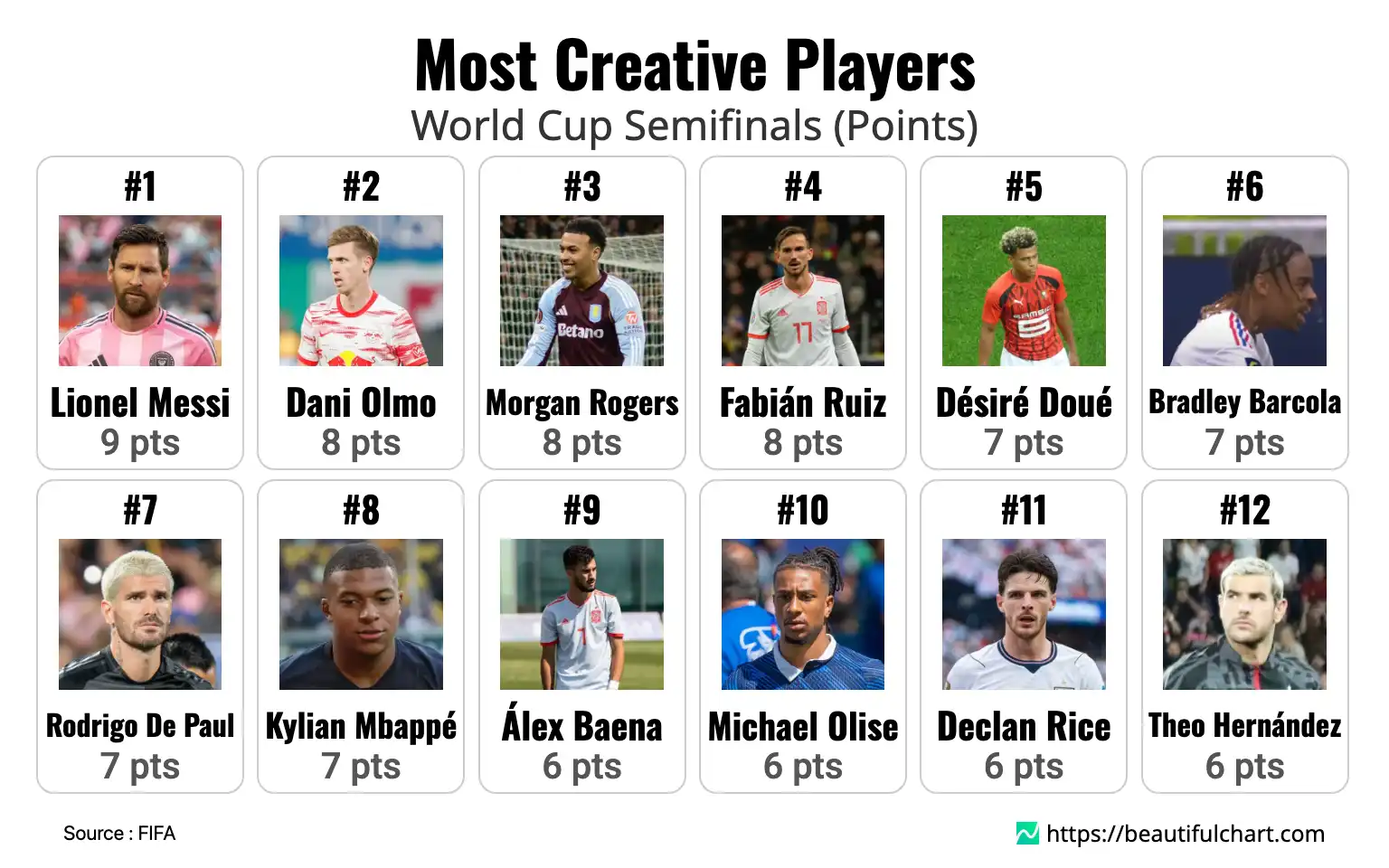
Lionel Messi, topping the creativity rankings with an incredible 9.1 points, orchestrated a comeback for the ages. Despite being heavily marked, his unparalleled vision allowed him to find Enzo Fernández for the crucial equalizer from outside the box. The momentum had completely swung. In the dying moments of stoppage time, Messi once again delivered a devastatingly accurate cross, allowing Lautaro Martínez to head home the winner. This match was a perfect example of how a single creative genius can override tactical stalemates and secure victory from the jaws of defeat.
The Evolution of the Playmaker
These semi-final matches highlighted a shift in how creativity is deployed on the modern pitch. We are moving away from the traditional, static number ten who waits for the ball. Today's most effective creators are dynamic, constantly moving, and contributing defensively. They operate in deeper roles or drift wide to escape man-marking. The high scores of players like Dani Olmo and Morgan Rogers reflect this trend. They are not just passing the ball; they are driving into space, disrupting defensive lines with both their movement and their distribution.
Furthermore, the data suggests that creativity is becoming increasingly decentralized. While a standout star like Messi can still dominate the rankings, successful teams like Spain rely on a network of creative players rather than a single focal point. This distributed playmaking approach makes a team much harder to defend against, as shutting down one player simply opens up space for another. It is a fascinating tactical evolution that promises to make future tournaments even more unpredictable and exciting to watch.

2026 World Cup Semi-Finals Creativity Power Rankings Explained
The semi-finals of the tournament brought incredible moments of individual brilliance and playmaking ability.
Data Source: FIFA
Image Source: Freepik from www.flaticon.com
Key Takeaways
Tactical Battles
- The semi-final matches were characterized by intense midfield battles where space was at a premium.
- Defensive solidity was prioritized, making moments of creative brilliance even more decisive.
- Teams had to adapt their formations dynamically to counter the specific threats posed by opposition playmakers.
The Value of Vision
- High creativity scores correlate strongly with players who can deliver unexpected, defense-splitting passes.
- Players capable of executing high-risk, high-reward plays often tipped the scales in their team's favor.
- The ability to maintain composure and vision under extreme pressure was a key differentiator.
Impact of Substitutions
- Fresh legs introduced in the second half significantly altered the creative dynamics of the matches.
- Substitutes who could immediately inject pace and inventive passing disrupted tired defensive lines.
- Managers utilized their benches effectively to shift the tactical balance and create new attacking avenues.
Top Ranking
#1 Lionel Messi 9.1 pts
The legendary Argentine once again proved that age is just a number when it comes to vision and playmaking. His ability to dictate the tempo and deliver pinpoint assists under immense pressure was unparalleled, culminating in a dramatic two-assist performance that propelled his team to the finals.
#2 Dani Olmo 8.1 pts
A crucial cog in the Spanish midfield machine, he consistently found pockets of space between the lines. His intricate passing and quick decision-making were instrumental in breaking down the opposition's defensive structures, allowing Spain to maintain offensive pressure.
#3 Morgan Rogers 7.8 pts
An incredible revelation in the tournament, providing a spark of unpredictable creativity. His driving runs and clever ball distribution constantly kept defenders guessing and created valuable attacking opportunities in tightly contested moments.
#4 Fabián Ruiz 7.6 pts
The Spanish maestro controlled the center of the pitch with exceptional composure and technical ability. His precise long-range passing and ability to switch play effectively stretched the opposing defense, creating gaps for his teammates to exploit.
#5 Désiré Doué 7.1 pts
The young French talent showcased remarkable flair and inventiveness despite his team's struggles. His dribbling skills and willingness to attempt unconventional passes brought a much-needed creative edge to the French attacking efforts.
| Rank | Name | Indicator | Subindicator |
|---|---|---|---|
1 |  Lionel Messi | 9 pts | Attack - 3 |
2 |  Dani Olmo | 8 pts | Attack - 3 |
3 |  Morgan Rogers | 8 pts | Attack - 4 |
4 |  Fabián Ruiz | 8 pts | Attack - 16 |
5 |  Désiré Doué | 7 pts | Attack - 4 |
6 |  Bradley Barcola | 7 pts | Attack - 7 |
7 |  Rodrigo De Paul | 7 pts | Attack - 7 |
8 |  Kylian Mbappé | 7 pts | Attack - 5 |
9 |  Álex Baena | 6 pts | Attack - 12 |
10 |  Michael Olise | 6 pts | Attack - 10 |
11 |  Declan Rice | 6 pts | Attack - 6 |
12 |  Theo Hernández | 6 pts | Attack - 14 |
12 |  Lamine Yamal | 6 pts | Attack - 11 |
14 |  Djed Spence | 6 pts | Attack - 15 |
15 |  Rayan Cherki | 6 pts | Attack - 14 |
16 |  Ezri Konsa | 6 pts | Attack - 9 |
17 |  Ferran Torres | 6 pts | Attack - 9 |
18 |  Enzo Fernández | 6 pts | Attack - 2 |
19 |  Jules Koundé | 6 pts | Attack - 23 |
20 |  Harry Kane | 6 pts | Attack - 13 |