
This ranking illustrates the massive scale of user engagement across the world's most popular digital platforms. The data highlights a clear hierarchy where the Meta ecosystem continues to hold a staggering lead, while video-centric and messaging-focused apps solidify their positions as essential daily tools. It provides a snapshot of how billions of people are currently navigating the interconnected web of social interaction, entertainment, and communication.
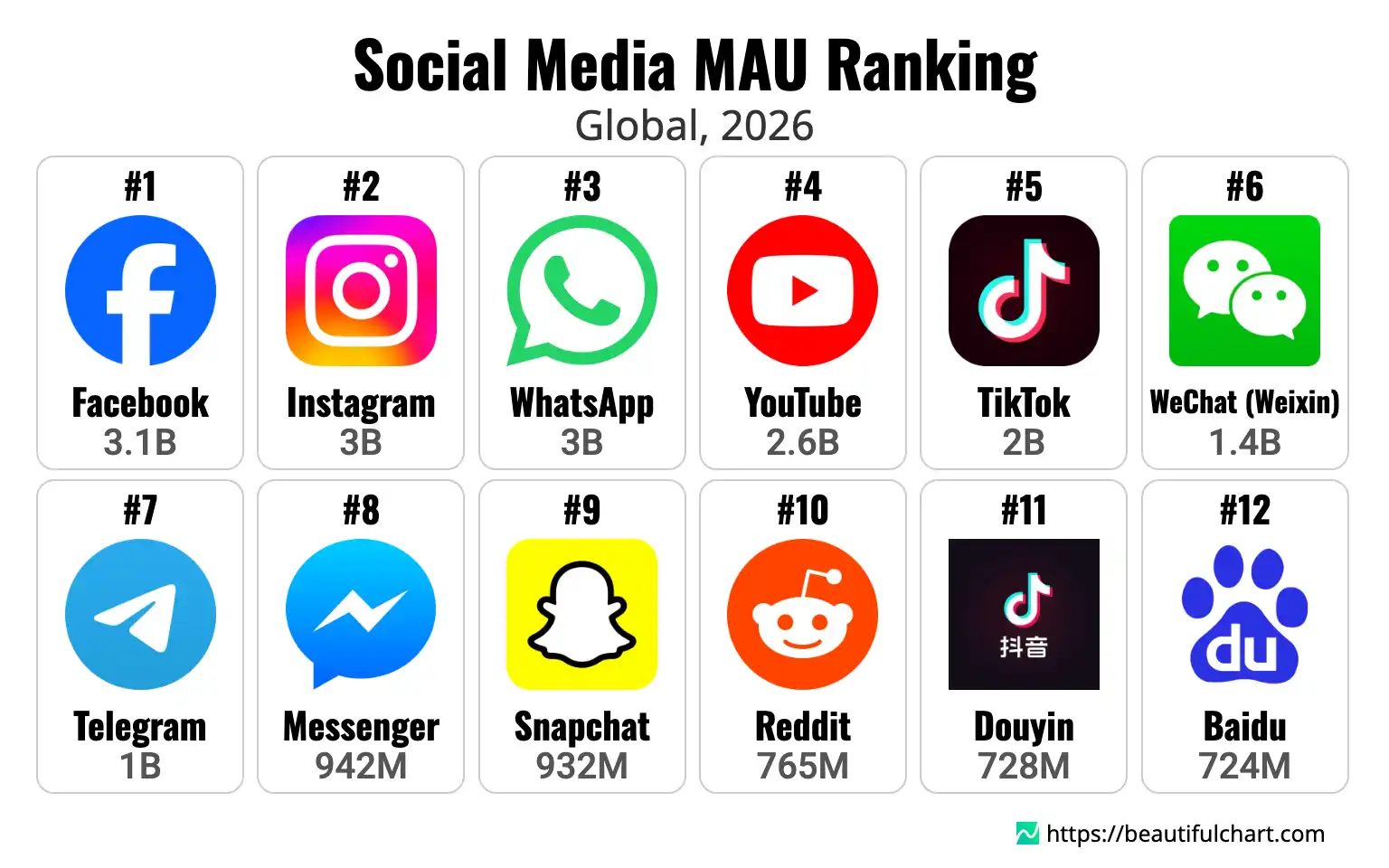
Monthly Active Users (MAU) is a key performance metric used by digital platforms to measure the number of unique visitors who engage with the service at least once within a 30-day period. It serves as a primary indicator of a platform's overall reach, user retention, and commercial viability for advertisers.
When we look at the sheer numbers behind global connectivity, it is hard to wrap your head around the scale. We are talking about billions of people—not millions—logging into these platforms every single month. It is fascinating to see how the hierarchy of the digital world has stabilized, yet continues to evolve in subtle ways. For any professional or individual keeping an eye on where the world is heading, these figures represent more than just statistics; they represent where human attention is currently focused.
At the very top, the Meta empire remains an absolute juggernaut. It is quite remarkable that Facebook, a platform many predicted would fade away years ago, still maintains its position as the undisputed king. It has evolved from a simple social networking site into a fundamental global utility. In the United States and across the globe, it serves as a primary source of news, marketplace activity, and community organization. But what is even more interesting is how its siblings, Instagram and WhatsApp, have caught up. Both have reached the 3 billion user mark, showing that the way we consume content is splitting between visual storytelling and private, encrypted communication. Instagram has successfully pivoted into the e-commerce and short-form video space, while WhatsApp has become the backbone of daily logistics for both individuals and businesses.
Then we have the heavy hitters in the video space. YouTube continues to be the primary destination for long-form content, education, and entertainment. It is essentially the modern-day television, but with a global reach that no traditional network could ever dream of. On the other hand, TikTok has completely disrupted the attention economy. Its rise to 2 billion users is a testament to the power of algorithmic discovery. It has forced every other platform to rethink how they present content to users, leading to the creation of 'reels' and 'shorts' across the board. This competition for our minutes and seconds is fiercer than ever.
Beyond the top five, we see a more fragmented but equally important landscape. Platforms like WeChat show the immense power of localized 'super-apps' that integrate everything from payments to social networking. Meanwhile, the rise of Telegram suggests a growing global demand for privacy and large-group communication that isn't tied to the traditional big tech structures. It is also worth noting the resilience of platforms like Reddit, which have carved out a massive niche for text-based, community-driven discussion. The diversity here is key; whether it is professional networking on LinkedIn or visual inspiration on Pinterest, there is a specialized corner of the internet for every possible interest. This distribution of users suggests that while the giants hold the most territory, there is still plenty of room for specialized platforms to thrive by serving specific human needs.

2026 Global Social Media User Rankings
This ranking illustrates the massive scale of user engagement across the world's most popular digital platforms.
Key Takeaways
The Meta Ecosystem Dominance
- Meta continues to lead the global market with three separate platforms surpassing the 3 billion user threshold.
- Facebook maintains its legacy as the most used platform, proving its staying power despite shifting trends.
- The integration of commerce and communication within these apps keeps user retention incredibly high.
The Rise of Video and Messaging
- YouTube and TikTok represent the pinnacle of video consumption, capturing a massive share of global attention spans.
- Video content has moved from being a secondary feature to the primary driver of engagement for the top-tier platforms.
- High-growth messaging apps like WhatsApp and Telegram highlight a shift toward private, direct communication over public broadcasting.
Regional Giants and Niche Communities
- Significant user bases are concentrated in region-specific apps like WeChat and Douyin, reflecting the digital landscape's geographic diversity.
- Special-interest platforms like Reddit and Pinterest continue to grow, showing that users still value curated, topic-specific communities.
- The variety of platforms suggests that users are increasingly diversifying their digital presence across multiple specialized apps.
Top Ranking
#1 Facebook 3.1B
Facebook remains the world's largest social network, serving as a global hub for communities, news, and marketplace interaction. Its massive user base is a result of its long-standing presence and its ability to adapt to diverse demographic needs across virtually every country, making it an essential tool for both personal and professional use.
#2 Instagram 3B
Instagram has evolved from a simple photo-sharing app into a visual powerhouse that defines modern digital culture. With 3 billion users, it is the primary platform for influencers, brands, and creators. Its heavy investment in video through Reels and its integrated shopping features have made it a central pillar of the creator economy.
#2 WhatsApp 3B
Sharing the second spot, WhatsApp has become the definitive global messaging standard. It offers more than just text; it is a vital platform for voice calls, status updates, and increasingly, business-to-consumer communication. Its commitment to end-to-end encryption has made it a trusted tool for billions who prioritize private and secure messaging.
#4 YouTube 2.6B
As the world's largest video-sharing platform, YouTube acts as a search engine, an educational resource, and an entertainment giant all in one. It bridges the gap between traditional media and user-generated content, offering a monetization model that has sustained professional creators for over a decade while expanding into live streaming and short-form video.
#5 TikTok 2B
TikTok's meteoric rise to 2 billion users has fundamentally changed how content is consumed and produced. Its algorithm-driven feed specializes in viral, short-form entertainment that transcends language barriers. It has become a trendsetter for global culture, influencing music charts, shopping habits, and the design of competing social media platforms.
| Rank | Name | Indicator |
|---|---|---|
1 |  Facebook Facebook | 3B 70M |
2 |  Instagram Instagram | 3B |
2 |  WhatsApp WhatsApp | 3B |
4 |  YouTube YouTube | 2B 580M |
5 |  TikTok TikTok | 1B 990M |
6 |  WeChat (Weixin) WeChat (Weixin) | 1B 410M |
7 |  Telegram Telegram | 1B |
8 |  Messenger Messenger | 942M |
9 |  Snapchat Snapchat | 932M |
10 |  Reddit Reddit | 765M |
11 |  Douyin Douyin | 728M |
12 |  Baidu Baidu | 724M |
13 |  Kuaishou Kuaishou | 715M |
14 |  Spotify Spotify | 713M |
15 |  Weibo Weibo | 588M |
16 |  Pinterest Pinterest | 578M |
17 |  X (Twitter) X (Twitter) | 557M |
18 |  Qzone Qzone | 532M |
18 |  QQ QQ | 532M |
20 |  Quora Quora | 400M |


