The semi-final matches of the 2026 FIFA World Cup, hosted across North America including the United States, delivered intense tactical battles where defensive solidity proved absolutely crucial. We have closely analyzed the defensive performances of the four semi-finalists to uncover who truly controlled the game from the back. This comprehensive ranking highlights the players who demonstrated exceptional positional awareness, tackling efficiency, and pressure resistance under the brightest lights.
A power ranking is a quantitative and qualitative assessment used to evaluate and order entities based on their current performance levels. Unlike traditional standings, it often heavily weighs recent momentum, tactical execution, and overall impact on the game flow.
The Blueprint of Modern Defending
The semi-final stage of the World Cup, hosted across the North American continent, showcased a fascinating contrast in tactical philosophies, particularly in how teams managed defensive transitions and neutralized opposing threats. The matches clearly revealed that modern defending is no longer solely about physical dominance or last-ditch tackles; it heavily relies on spatial awareness, proactive pressing, and the ability to dictate the tempo from deep positions.
The clash between France and Spain was a masterclass in collective defensive organization. Spain's approach was characterized by a high-density defensive block and a relentless pressing scheme that effectively suffocated the French attack. By cutting off passing lanes and isolating key forwards, the Spanish side prevented their opponents from registering a single shot on target in the first half. This level of control requires exceptional coordination from the entire defensive unit, specifically the central defenders and the holding midfielder, who act as the fulcrum of the team's defensive shape. The proactive nature of their fullbacks also added an extra layer of defensive security, allowing them to recover quickly during defensive transitions and intercept passes before they reached dangerous areas.
Tactical Resilience in High-Stakes Matches
Conversely, the encounter between Argentina and England highlighted the critical importance of risk management and adaptive defensive strategies. Both teams initially adopted a highly cautious approach, prioritizing defensive solidity over expansive attacking play. The focus was heavily placed on neutralizing the opposition's primary playmakers, resulting in a tense, tactical stalemate characterized by extremely limited scoring opportunities in the central areas of the pitch.
However, the dynamics of the match shifted drastically following the opening goal. The subsequent phases of the game perfectly demonstrated how defensive structures must instantly adapt to rapidly changing game states. As the trailing team commits more bodies forward in desperate search of an equalizer, the defensive burden on the remaining players intensifies exponentially. The ability of a defensive midfielder to shield the backline, break up rapid counter-attacks, and calmly initiate forward movements under severe pressure becomes paramount. The highest-rated defensive performers in these high-pressure scenarios were those who exhibited unwavering concentration, precise tackling timing, and the profound tactical intelligence to consistently anticipate the opposition's attacking patterns. The evolution of defensive roles is clearly visible at this elite level, with central defensive midfielders now frequently acting as the primary deep-lying playmakers while simultaneously executing critical defensive duties to maintain overall team balance and structure.

2026 FIFA World Cup Semi-Final Defensive Power Rankings
The semi-final matches of the 2026 FIFA World Cup, hosted across North America including the United States, delivered intense tactical battles where defensive solidity proved absolutely crucial.
Data Source: FIFA
Image Source: Freepik from www.flaticon.com
Key Takeaways
Tactical Discipline
- Successful teams prioritized maintaining a compact defensive shape to limit the opponent's space in dangerous areas.
- High-pressing systems were highly effective in disrupting the build-up play of the opposing side from the very beginning.
- Fullbacks played a crucial dual role, providing both defensive stability and an outlet for rapid counter-attacks.
- Effective communication among the back four was essential for executing offside traps and marking assignments.
Impact of Defensive Midfielders
- The role of the holding midfielder was pivotal in breaking up opposition attacks before they reached the penalty area.
- These players excelled at intercepting passes and reading the game to anticipate the next offensive movement.
- Beyond defending, they served as the primary link in transitioning the ball from defense to attack.
- Their ability to withstand intense pressure while retaining possession proved to be a decisive factor in controlling the match tempo.
Top Ranking
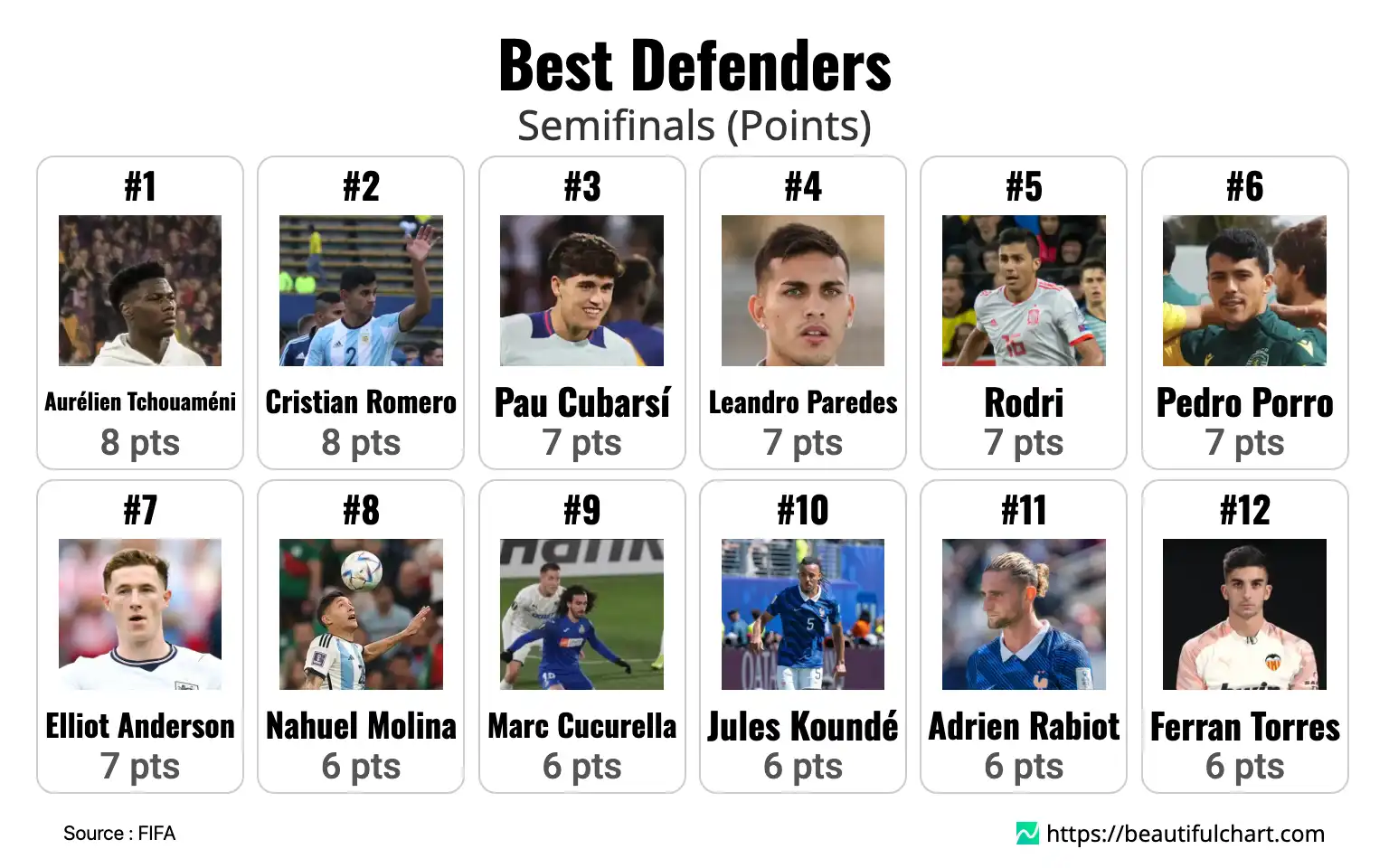
#1 Aurélien Tchouaméni 8.16
Aurélien Tchouaméni anchored the midfield with exceptional tactical discipline and physical presence. Despite team struggles, his ability to read the game and intercept crucial passes prevented numerous dangerous attacks. He consistently won aerial duels and provided a reliable shield for the backline. His incredibly high rating reflects his immense individual defensive contribution under relentless pressure.
#2 Cristian Romero 7.79
Cristian Romero delivered a commanding performance at the heart of the defense, combining aggressive tackling with highly intelligent positioning. He successfully neutralized key attackers through proactive marking and perfectly timed interceptions. His leadership and vocal organization of the defensive line were absolutely instrumental in maintaining structural integrity during the most tense periods of the match.
#3 Pau Cubarsí 7.35
Pau Cubarsí showcased remarkable maturity, offering a masterclass in modern center-back play. His extraordinary composure on the ball allowed his team to effortlessly bypass the press and build attacks. Defensively, his sharp anticipation and precise reading of the game enabled him to extinguish threats early. His seamless performance in this high-stakes environment underscores his exceptional defensive talent.
#4 Leandro Paredes 7.19
Leandro Paredes brought critical combativeness and control, acting as a relentless disruptor of the opposition's rhythm. His aggressive pressing and tenacious tackling effectively limited the time and space available to playmakers. Furthermore, his precise passing range was vital in rapidly transitioning defense into attack. His immense work rate provided the essential balance needed for team defensive stability.
#5 Rodri 6.97
Rodri orchestrated the tempo with customary brilliance, functioning as the vital defensive linchpin. His exceptional positional awareness was crucial in stifling dangerous counter-attacks before they could develop. He expertly shielded the defensive line, consistently recovering possession through intelligent interceptions rather than desperate tackles. His calm execution provided the foundation for a dominant defensive display.
| Rank | Name | Indicator | Subindicator |
|---|---|---|---|
1 |  Aurélien Tchouaméni | 8 pts | Attack - 18 |
2 |  Cristian Romero | 8 pts | Attack - 25 |
3 |  Pau Cubarsí | 7 pts | Attack - 20 |
4 |  Leandro Paredes | 7 pts | Attack - 10 |
5 |  Rodri | 7 pts | Attack - 21 |
6 |  Pedro Porro | 7 pts | Attack - 1 |
7 |  Elliot Anderson | 7 pts | Attack - 22 |
8 |  Nahuel Molina | 6 pts | Attack - 20 |
8 |  Marc Cucurella | 6 pts | Attack - 24 |
10 |  Jules Koundé | 6 pts | Attack - 23 |
11 |  Adrien Rabiot | 6 pts | Attack - 8 |
12 |  Ferran Torres | 6 pts | Attack - 9 |
13 |  Nicolás Otamendi | 6 pts | Attack - 12 |
14 |  Maxence Lacroix | 6 pts | Attack - 19 |
15 |  Dayot Upamecano | 6 pts | Attack - 25 |
15 |  Dani Olmo | 6 pts | Attack - 3 |
17 |  Nicolás González | 6 pts | Attack - 5 |
18 |  Aymeric Laporte | 6 pts | Attack - 21 |
19 |  Fabián Ruiz | 6 pts | Attack - 16 |
20 |  Giuliano Simeone | 6 pts | Attack - 20 |